58-59 Balaji Nagar, St Stephen Circle, Makarwali Road, Ajmer, Rajasthan 305004

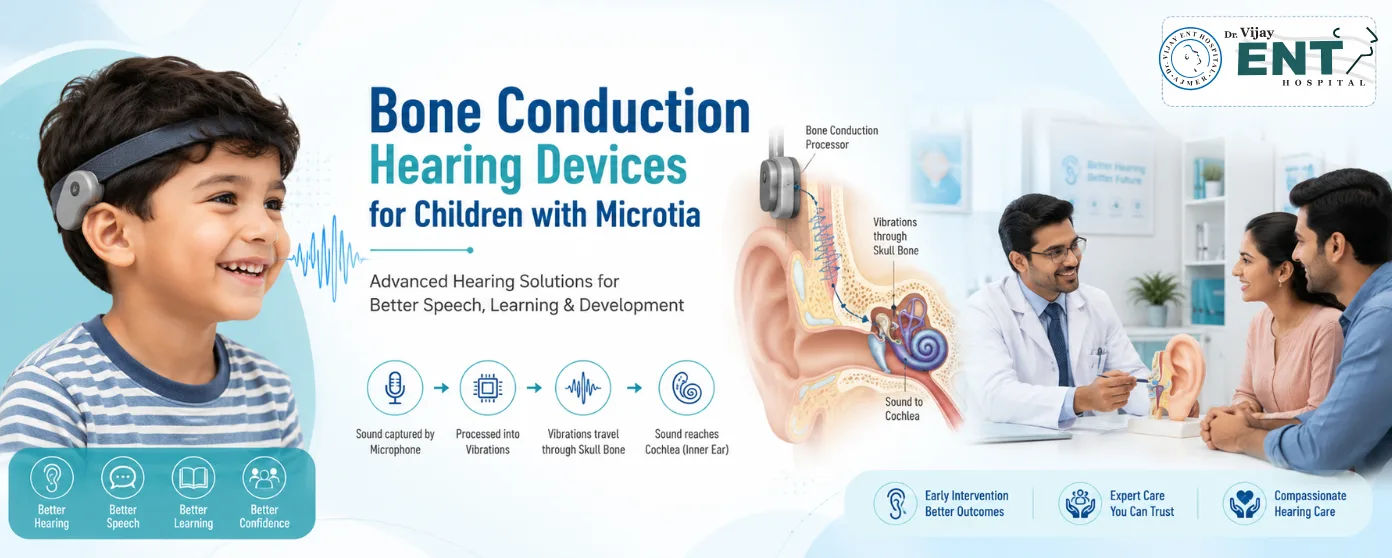
When a child is born with microtia, parents often have concerns about both ear appearance and hearing development. While reconstructive procedures can improve the appearance of the outer ear, hearing rehabilitation is equally important for speech, language, learning, and social development.
One of the most effective hearing solutions for children with microtia is a bone conduction hearing device. These devices bypass the outer and middle ear and transmit sound directly to the inner ear, helping children with conductive hearing loss hear more effectively. Early hearing intervention can support communication skills, academic performance, and overall confidence.
This article explains how bone conduction hearing devices work, their benefits, and the different options available for children with microtia.
Microtia is a congenital condition where the outer ear doesn’t form the right way during pregnancy. It ranges from a bit smaller-looking ear to a complete absence of the outer ear parts.
Microtia is a relatively rare congenital condition, affecting approximately 1 in every 5,000 to 10,000 births worldwide. Many children with microtia also have aural atresia, which can result in conductive hearing loss because sound cannot travel normally through the outer and middle ear.
The condition may occur on one or both sides, and treatment options for microtia depend on the severity and associated hearing loss. In a lot of cases, it also comes with atresia, which is when the ear canal is missing or just not properly developed.
Even though the inner ear often works fine, the sound still struggles to get through because the outer and middle ear structures are impacted. So, this usually leads to conductive hearing loss.
The real amount of hearing loss changes a lot, depending on how severe it is. Some kids may notice only mild hearing troubles, while others have major hearing impairment.
If hearing loss is left untreated, it can impact multiple areas in a child’s growth, like:
That’s why early support is so important. Hearing aids for microtia and other hearing assistance technologies can make a big difference here. ENT specialists and audiologists generally recommend early hearing assessment for children with microtia to determine the degree of hearing loss and identify the most appropriate hearing rehabilitation options. Early intervention plays an important role in supporting speech and language development as part of microtia treatment and care.
A bone conduction hearing device for microtia is basically a hearing technology designed to bypass the damaged or missing outer and middle ear parts, as it doesn’t really rely on them.
Unlike classic hearing aids that amplify sound through the ear canal, bone conduction systems send sound vibrations straight through the skull bone, then to the inner ear.
Because lots of kids with microtia still have working inner ear function, these devices help deliver the sound information to the cochlea without needing a fully formed ear canal.
Bone conduction technology has, in many cases, turned out to be one of the strongest hearing options for children dealing with conductive hearing loss tied to microtia or other ear canal issues.
These types of devices are often suggested when:
Many children notice clear gains in hearing, day-to-day communication, and even learning once they start using these devices.
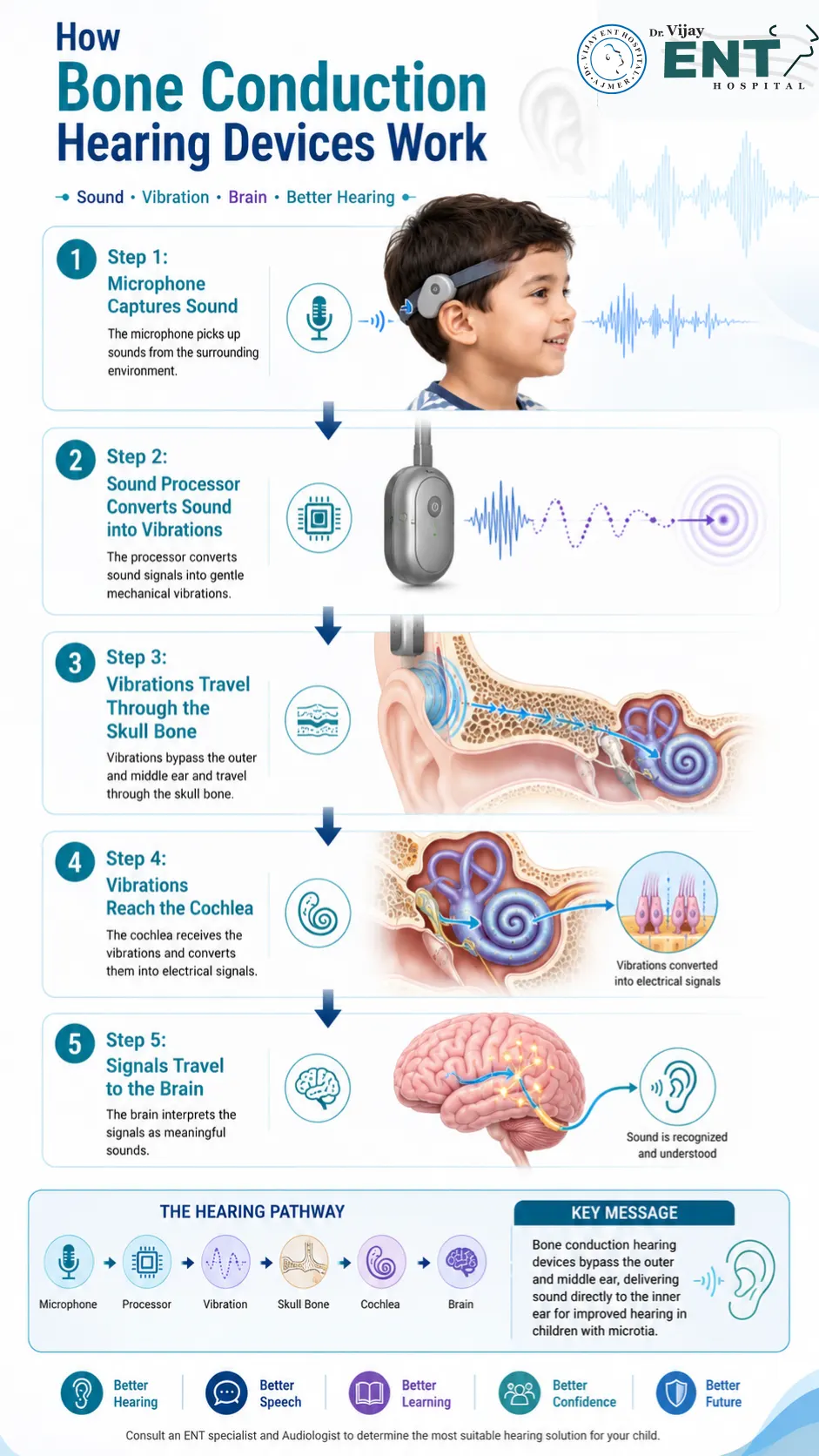
To understand why these devices can be so helpful, it’s useful to get the idea of how normal hearing happens in the first place. Usually, sound waves travel into the outer ear, then move down the ear canal; they make the eardrum vibrate, and after that, they go through the tiny middle ear bones before reaching the inner ear.
In kids who have microtia and atresia, that normal path isn’t working the same way. Part of the route gets interrupted, so the sound doesn’t get through as it should.
Bone conduction devices take a different track, not the usual one. The system is basically made up of:
The microphone picks up everyday noises from the surroundings.
The sound processor converts incoming sounds into gentle vibrations that are transmitted through the skull bone.
Those vibrations are sent through the skull bone straight toward the cochlea in the inner ear., bypassing the outer and middle ear completely.
When these vibrations reach the cochlea, it turns them into electrical impulses, and those signals then get sent to the brain so they can be understood as sound.
Since the inner ear is often still doing its job for microtia patients, this kind of technology lets children hear more effectively even when the outer ear is abnormal.
That’s why bone conduction devices are now considered among the most dependable hearing aids for microtia that are available today.
Depending on a child’s age, specific hearing needs, and whether it fits medically, there are different bone conduction devices you might consider.
These are often chosen for infants and toddlers in the first stages.
The hearing processor sits on or is attached to a soft headband that holds the device snugly against the skull.
Some advantages:
A lot of children start using softband devices not long after they’re diagnosed.
With adhesive systems, the fixation is done using an adhesive backing placed just behind the ear.
Then the hearing processor links to the adhesive adapter, with no need for surgery.
Common advantages are:
As children grow older and approach the best age for microtia surgery, some may also be evaluated for implantable hearing solutions.
One of the most widely used implantable options is the Bone Anchored Hearing Aid (BAHA). The device uses a small titanium implant placed in the bone behind the ear, allowing sound vibrations to be transmitted directly to the inner ear.
In this case, there is a small implant placed into the skull bone behind the ear.
After that, the sound processor stays on the outside and sends vibrations through the implant for sound transmission.
Possible benefits include:
Whoever gets an implant really depends on age, how the bone is developing, and an ENT specialist’s medical assessment.
Parents should also understand the questions to ask before microtia surgery when planning long-term treatment and hearing rehabilitation. Early testing helps determine whether hearing loss is present and allows specialists to recommend appropriate treatment options.
A hearing evaluation may include:
• Newborn hearing screening
• Auditory Brainstem Response (ABR) testing
• Behavioural hearing assessments
• Audiological evaluations as the child grows
Early identification and treatment of hearing loss can significantly improve speech, language, and educational outcomes.
Bone conduction hearing devices provide an effective hearing solution for many children born with microtia and conductive hearing loss. By bypassing the outer and middle ear and transmitting sound directly to the inner ear, these devices can support speech development, communication, learning, and overall quality of life.
Whether a child uses a softband device, an adhesive system, or a Bone Anchored Hearing Aid (BAHA), early diagnosis and timely intervention are essential for achieving the best hearing outcomes.
If your child has microtia or hearing difficulties, consulting an expert Microtia Surgeon in India can help determine the most suitable treatment and hearing rehabilitation options.
Many children with microtia have a normally functioning inner ear but experience conductive hearing loss because the outer ear or ear canal is underdeveloped.
Non-surgical options such as softband bone conduction devices can often be used during infancy following specialist evaluation.
No. Eligibility depends on factors such as age, skull bone development, hearing status, and medical assessment by an ENT specialist.
Ear reconstruction surgery primarily improves the appearance of the ear. Hearing improvement may require separate hearing rehabilitation procedures or hearing devices.
The most suitable device depends on the child’s age, hearing loss severity, and anatomy. Bone conduction hearing devices are among the most commonly recommended options for conductive hearing loss associated with microtia.

Dr. Vijay Gakhar is a renowned ENT specialist and expert Microtia surgeon in Rajasthan, India. Carrying the MBBS degree from the prestigious SMS Medical College, Jaipur, he holds specialisation with an MS in Otolaryngology ENT (Ear, Nose, and Throat) from Jawaharlal Nehru Medical College (JLN), Ajmer. Besides known for performing the best ear reconstruction surgeries, Dr. Gakhar grabs expertise in all other ENT services such as Septoplasty, Myringoplasty, Nasal Endoscopy, Commando Surgery, and FESS (Functional Endoscopic Sinus Surgery), for over 20 years.