58-59 Balaji Nagar, St Stephen Circle, Makarwali Road, Ajmer, Rajasthan 305004


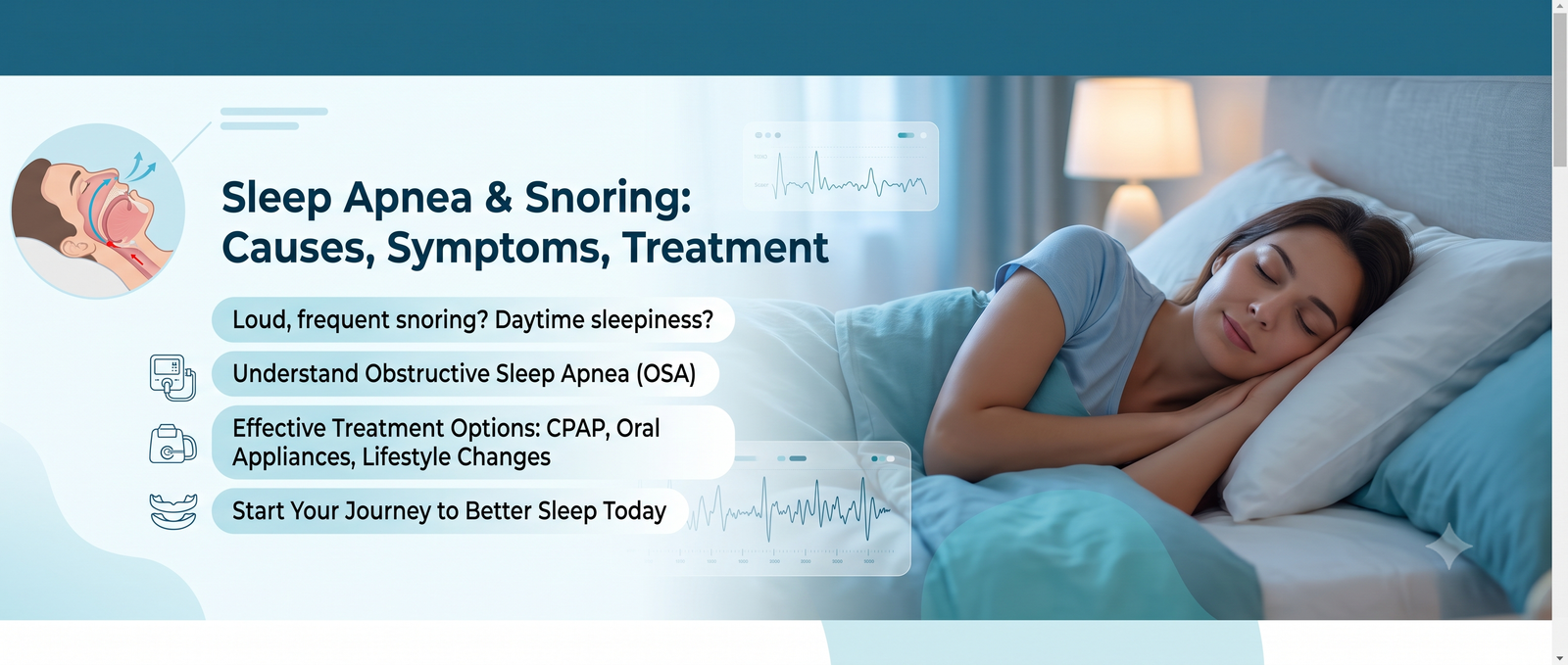
Snoring is one of those irritating sounds that comes not often from somewhere that one would expect to be quite an issue, and lots of people take pride in their snoring. But, habitual or loud snoring is a sign of possible irregular breathing patterns in sleep.
So if you find yourself snoring loudly, wake up gasping for air, feeling tired after hours of sleep or someone has noticed you stop breathing during sleep. You should seek medical attention.
There are a variety of possible causes for these symptoms but one of the most common is sleep apnea which refers to a group of sleep disorders characterised by pauses in breathing during sleep. The most prevalent type of sleep apnea is obstructive sleep apnea (OSA). it occurs when the airway narrows during sleep, obstructing the airflow and causing episodes of apnea (cessation of breathing). Luckily, sleep apnea as well as snoring are both curable conditions. There are various treatments for sleep apnea which is depending on the underlying causes and severity of symptoms.
The term sleep apnea is generally used to refer to a condition where one experiences pauses in breathing for short periods of time during sleep. There are two types of sleep apnea namely, obstructive and central. Obstructive occurs when one’s throat muscles relax at night thus causing their airway to narrow. It is quite common for individuals to experience instances where they find it difficult to breathe while asleep but, doing this often is an indication of obstructive sleep apnea.
On the other hand, central sleep apnea results from one’s brain having difficulties sending appropriate signals to their breathing muscles. Central sleep apnea is independent of obstructive sleep apnea and requires different tests and treatment. When searching for treatment for sleep apnea, one is mostly interested in obstructive sleep apnea.
No. Snoring happens when air vibrates tissues in the airway and is common and can occur even in people who do not have sleep apnea.
However, heavy snoring accompanied by pauses in breathing or choking or gasping for air during sleep can be an indication of sleep apnea. Loud snoring without addressing the underlying cause would not address the sleep disorder. This is why simply looking for a snoring treatment without finding the cause may not solve the real problem.
There are many potential causes of snoring. Some people may be more prone to it due to the structure of their nose or throat while other factors such as being tired or sleeping on their back may also play a role.
Common causes include:
The specific cause may vary from person to person.
Most people don’t realize their own sleep apnea symptoms. Often, it is a bed partner or a family member. Common signs of sleep apnea during the night are :
During the day, symptoms may include:
These symptoms can affect daily work, studies, relationships and other activities.
There are several possible risk factors for sleep apnea. The disorder may occur in people of different ages and body types. However some factors can increase the risk of sleep apnea. These include
Having any of these risk factors does not guarantee that a person will develop sleep apnea, and some people who have the condition do not have obvious risk factors.
Although occasional snoring is normal in many people, habitual and noisy snoring should not be ignored.
A medical consultation is recommended if:
• You have loud snoring,
• your partner tells you that you stop breathing during sleep,
• you often wake up choking or gasping for air,
• you have daytime sleepiness,
• you often have headaches when waking up or feel that your mouth is dry,
• you have trouble concentrating,
• you are always tired and sleepy even after a good night’s sleep or
• snoring interferes with your sleep or the sleep of your partner.
If you experience daytime sleepiness, this is a reason to see a doctor right away. This is because it is more dangerous when you fall asleep at the wheel while driving. In these situations it is better to be safe than sorry so rather see the doctor and assume that it is not caused by lack of sleep at night than to risk falling asleep behind the wheel.
A diagnosis typically begins with a discussion of your symptoms, sleep habits and medical history. Your doctor may also examine your nose, mouth and throat to look for possible causes of airway obstruction.
Information from a partner can also be valuable, since they may have seen you snoring or have paused breathing while you sleep which you may not be aware of.
A sleep study, also known as polysomnography is a common procedure used to diagnose sleep apnea. During an overnight sleep study, a variety of body functions are measured while you sleep, including:
A sleep study can confirm the presence of sleep apnea and estimate the severity of the condition.
For many people, a doctor may recommend a home sleep apnea test. These tests gather fewer measurements than a full night sleep study but can be effective in the right circumstances.
A home test is not right for everyone and a doctor may still suggest a full sleep study if the results are unclear or if another condition is suspected.
There is no treatment that suits everyone. The sleep apnea treatment options are dictated by the type of sleep apnea, its severity, the patient’s overall medical condition, and the cause of the disorder.
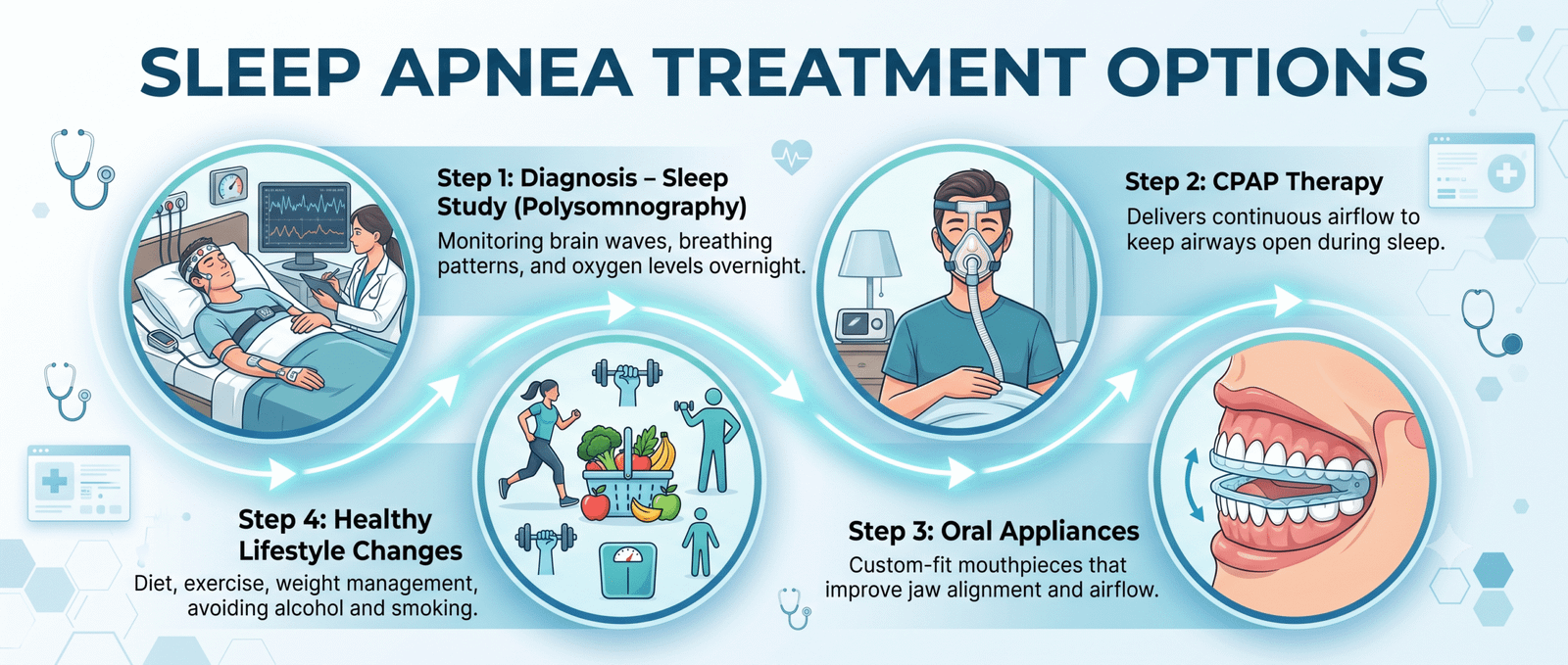
Sleep Apnea Treatment Options:
Lifestyle modifications, often in combination with other treatment options, may benefit some patients.
The doctor may recommend:
While these measures may help, they can’t be thought of as a replacement for other treatment options in the case of moderate to severe sleep apnea.
CPAP is a standard treatment for obstructive sleep apnea.
The machine generates air pressure to open up the patient’s airway during the night. It prevents the occurrence of apnea and hypopnea episodes and also decreases snoring in most cases.
The patient must wear a CPAP mask while sleeping to benefit from the therapeutic effect of the treatment.
An oral appliance may sometimes be an appropriate treatment option for patients with mild obstructive sleep apnea or for the ones who have difficulties following the CPAP treatment.
They should be custom-fitted by the dentist and need to be regularly followed up on to make sure that they are suitable for the patients’ oral health.
Nasal decongestants may be prescribed for patients with mouth breathing or narrow nasal passages. Snoring may sometimes be caused by nasal obstruction, so its elimination can lead to decreased snoring.
Surgical treatment of sleep apnea is usually prescribed for specific cases.
The surgeon will prescribe the suitable surgical intervention according to the location and the severity of the obstruction.
An ENT specialist will assess the condition of the nasal passages, oral cavity and throat to determine the reason for the disorder and whether a surgical intervention is indicated.
Surgery is not suggested for everyone with sleep apnea, and it is not necessarily indicated for everyone who snores.
It all depends on the reasons why you snore.
It is possible that changing your sleeping position, losing excess weight if you are overweight, avoiding drinking alcohol at bedtime, quitting smoking and getting rid of nasal congestion may help.
Nevertheless, if you suffer from obstructive sleep apnea… these measures may turn out to be insufficient.
The main thing is to determine not only how to get rid of snoring but also why exactly it occurs. Only in this way, you will be able to determine which treatment for snoring is best suited for your case.
Not only can lack of sleep make you feel tired the next day but pauses in breathing during the night can impair you from getting healthy deep sleeps and cause you to be excessively sleepy during the day. Untreated, sleep apnea can lead to health issues such as cardiovascular disease. However both the daytime sleepiness and health risks can be avoided with proper treatment.
Hence, habitual snoring coupled with daytime sleepiness can’t be ignored.
Most often, people who suffer from sleep apnea don’t know that they do and can go undiagnosed for years.
Someone may think that his or her snoring is normal or that their daytime tiredness is due to a demanding job, but the truth is that both habitual snoring and excessive daytime sleepiness are symptoms of sleep apnea. The problem is that most of the time the only one that knows is the sleep partner who sees the pauses in breathing. A sleep study can help confirm the suspicion and provide the proper treatment by the expert doctor.
The proper treatment may be as simple as decongestants if nasal passages are the issue or something as serious as a CPAP, oral appliance or surgery to correct obstructive sleep apnea.
Loud snoring does not imply that a person has sleep apnea since many people experience snoring however, do not have sleep apnea. Sleep apnea should be suspected if the person experiences snoring and cessation of breathing during sleep and daytime sleepiness.
The most effective treatment for sleep apnea depends on the type of sleep apnea and other factors. In most cases, CPAP is recommended as a first-line therapy for obstructive sleep apnea. Other treatments include oral appliances, lifestyle and dietary changes, treatment of nasal obstruction, and surgical procedures.
Weight loss is adviced for people with obesity since it can have multiple health benefits, including reducing sleep apnea symptoms. However it does not imply that one can stop with treatment for sleep apnea unless advised by a healthcare professional.
Like adults, children can also have experience of sleep apnea. The main difference is that sleep apnea in children can occur due to distinct factors. It is also important to note that treatment for sleep apnea in children is somewhat different from that of adults. Therefore, it is advisable to consult a healthcare provider if a child snores loudly or has trouble while sleeping.
If anyone experiencing snoring or sleep apnea should consult a doctor. In some cases, a sleep apnea specialist, ENT doctor, and respiratory therapist may be involved in the management of the condition. A consultation with an ENT doctor is always recommended to examine the nasal passages and evaluate if there are anatomical abnormalities contributing to snoring and sleep apnea.
Although it may sound simple, regular and loud snoring can actually be one of the signs of a possible sleep-related breathing issue.
If you or your partner have noticed loud snoring, pauses in breathing, choking during sleep or strange daytime drowsiness, you may want to get an evaluation to find out if there is a possible medical cause.
Once a physician has determined what the issue might be, the correct sleep apnea treatment or snoring therapy can be found.
Good sleep is not a luxury – it is a necessity and a fundamental part of keeping us healthy, awake and active during the day.

Dr. Vijay Gakhar is a renowned ENT specialist and expert Microtia surgeon in Rajasthan, India. Carrying the MBBS degree from the prestigious SMS Medical College, Jaipur, he holds specialisation with an MS in Otolaryngology ENT (Ear, Nose, and Throat) from Jawaharlal Nehru Medical College (JLN), Ajmer. Besides known for performing the best ear reconstruction surgeries, Dr. Gakhar grabs expertise in all other ENT services such as Septoplasty, Myringoplasty, Nasal Endoscopy, Commando Surgery, and FESS (Functional Endoscopic Sinus Surgery), for over 20 years.