58-59 Balaji Nagar, St Stephen Circle, Makarwali Road, Ajmer, Rajasthan 305004



When a baby child is born with a deformed small ear, the first question asked by his or her parents is about the therapy. Microtia is a congenital disease characterized by the inadequate development of the outer part of the ear. As a result, the baby may have an ear that is simply smaller than normal or deformed.
Ear molding is a nonsurgical approach intended to reshape the child’s deformed ear. It is based on the careful massaging of the cartilage during the first months of the baby’s life.
However, the effectiveness of such treatment is a controversial issue. The fact is that ear molding successfully treats some congenital ear deformities while others require a more reliable intervention.
As a result, even if ear molding makes the kid’s ear more esthetically pleasing, he or she may need an ear reconstructive surgery. Moreover the parents should know that ear molding is a safe and harmless procedure that does not harm their child’s health in any case.
Microtia is a congenital deformity of the external ear, also called the auricle or pinna. The deformity can either be present at birth or can occur later in life due to external factors.
It can range from a mild deformity to an almost complete absence of the outer ear. Microtia may be unilateral or bilateral. Sometimes it can be accompanied by ear canal deformity that may cause hearing problems so it is important to evaluate hearing as well.
As there are various types and degrees of deformity, individual assessment by an ENT or ear reconstruction specialist is required.
Ear molding is a non-surgical method of modifying the shape of a child’s auricle. A special molding system, splint, or some other individualized device is placed around the structure of the ear to help it grow into a specific shape. Ear molding does not require any incisions or other surgical interventions. The procedure is minimally invasive and usually well tolerated by the patient.
Since the consistency of the ear cartilage in newborns is more fluid, it can be easily shaped by ear molding during the first weeks of development. For this reason, early intervention is often recommended for congenital ear deformities that require surgery. In such cases, splint may need to be worn for a few weeks while the doctor monitors the progress of healing and checks the integrity of the skin.
That’s one of the most common questions parents ask.
Ear molding can sometimes help treat certain congenital ear abnormalities, but is not effective for all forms of Microtia.
That’s an important distinction.
In the case of some ear deformities in a newborn, the malformation is primarily deformational in nature. These ears have malformed or unusual shape or position and respond well to molding as some cartilage exists that can be coaxed into a new direction.
Microtia refers to a developmental malformation where part or all of the external ear may be malformed or absent. More severe cases of Microtia may require another type of repair besides molding.
Therefore, just because your child has been diagnosed with Microtia, it doesn’t necessarily mean that ear molding is a definite option. A specialist should be consulted to look at the affected ear(s) to determine if molding would be appropriate for the particular case.
The timeliness of the procedure is one of the most crucial factors concerning ear molding.
The reason for it is quite simple — the cartilage of a newborn’s ear is more pliable, while an adult’s or elder child’s ear is harder and less responsive to non-surgical interventions.
As mentioned in a study conducted to evaluate the effectiveness of non-surgical treatment for congenital ear deformities, there is a strong correlation between the age of a child at the time of intervention and the ultimate outcome. The systematic review and meta-analysis conclude with a high degree of precision that non-surgical treatments have an excellent efficacy rate for congenital ear deformities, and the earlier the intervention, the better the results.
This does not mean that non-surgical treatments are ineffective for older children and adults. It only means that the effectiveness of the procedure and its ability to restore the function and shape of the ear depend on multiple factors, including age, the severity of a particular deformity, and the type of intervention.
Yet, based on the findings, it would be reasonable for parents who suspect that their child has a congenital ear deformity to avoid waiting for the ear to “fix itself” and schedule an appointment with a qualified professional as soon as possible.
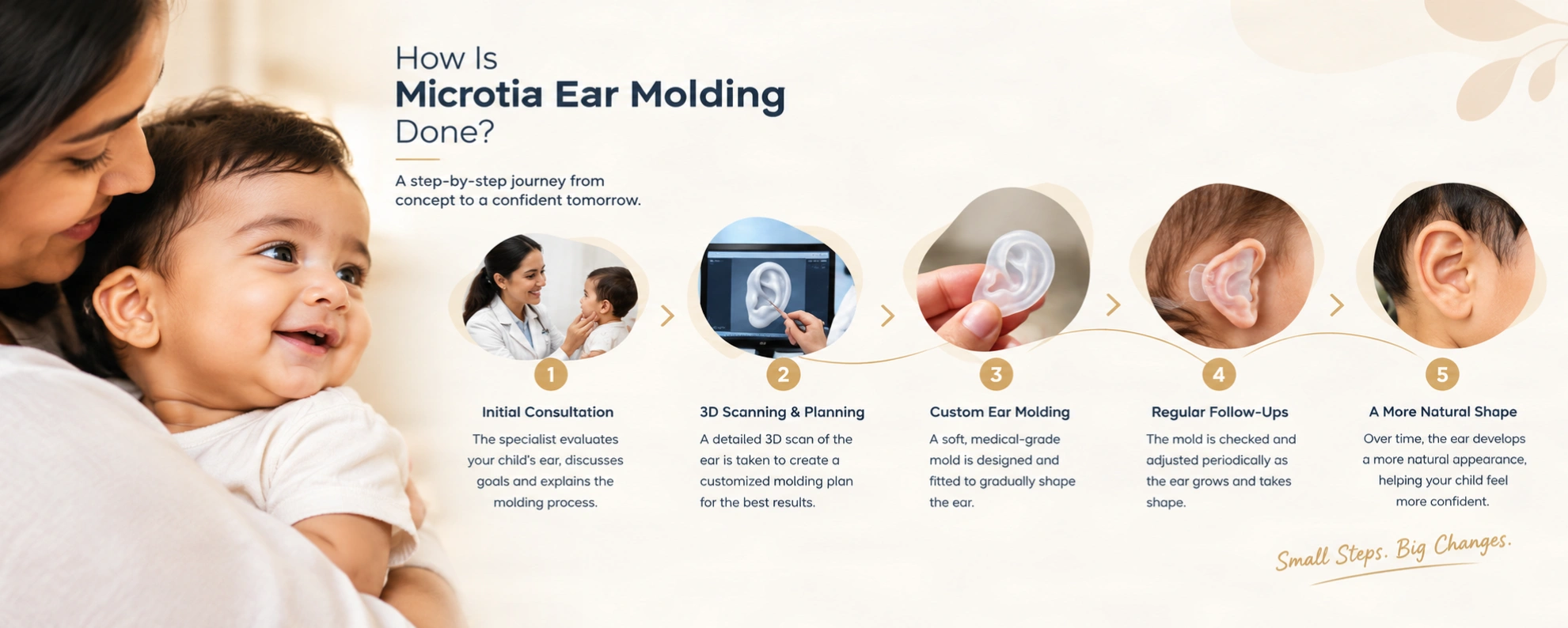
Every ear molding session for a qualifying patient has several unique particular steps.
As a first step, a doctor examines his/her child’s external ear to assess its shape, size and development.
During this procedure, the specialist also identifies if the case is classified as a deformity responsive to molding or a structural malformation which requires a different treatment.
Based on the appearance of his/her ear and the age of his/her child, the doctor selects an appropriate commercial molding system or a customized molding technique.
The objective is to restore the shape of his/her ear to its normal position and size by applying gentle pressure to it.
In the next step, the microtia surgeon recommends regular check-ups to evaluate the progress of the molded ear and whether there are no irritations or damages to his/her skin.
Furthermore, the doctor might need to make adjustments to the molding device to help his/her ear achieve the desired shape.
Depending on the patient’s condition, ear molding can be completed in weeks or months.
The treatment duration also depends on the time when molding was initiated, his/her age, the severity of his/her case and how his/her ear responds to the mold.
There are many benefits to ear molding for infants who are candidates for the procedure.
Probably the most beneficial aspect of ear molding would be a non-surgical treatment for malformed or misshapen ears.
Since no surgery is required, there would be no incisions, stitches, or surgical scars.
Some ear deformities can be corrected early in life with ear molding.
This could help prevent future surgeries, as the cartilage in an infant’s ear is more flexible and therefore easier to manipulate.
In some cases of ear deformities, if the molding is successful, there could be no need for further surgery to correct the issue, as the ear would have successfully been molded into the desired form.
However, in the case of severe Microtia, this would not apply, as the reconstructive surgery needed to reconstruct the ear would still need to be performed.
Studies of ear molding have shown that in general, the complications are minor, though there can be instances of irritation, redness, pressure sores or other ailments affecting the skin. Medical supervision is always needed while undergoing the ear molding procedure.
Yes. There are limitations of ear molding, as unfortunately the process is not universal for all kinds of congenital deformities.
The main factors which affect the outcome of the treatment are the following:
Another limitation is the fact that molding cannot create certain parts of the ear if they are missing, so in the case of severe Microtia, where the outer part of the ear is malformed, a reconstructive surgery to make a more presentable shape out of the existing tissue is necessary.
That is why it is important to consult with a specialist to define the best course of treatment.
Actually, they are not. The ear molding is a non-surgically procedure that reshapes the cartilage of the ear in infants. Microtia surgery is a surgical procedure that reconstructs the ear.
It depends on how its deformed. If it is minor, I think that ear molding should be fine. If it’s major, you might have to get it reconstructed as an infant or when you are older.
I would suggest going to a doctor and seeing what they suggest.
The later the ear molding procedures are done, the more challenging they may become as the cartilage becomes less flexible.
The studies on ear molding of neonates may help us to understand that the sooner the procedures are done, the better results we may achieve.
Nevertheless, the child’s age should not be a limiting factor for ear molding.
A specialist will evaluate the situation and discuss possible solutions.
In addition, we should not try to mold our children’s ears at home with various clips, tapes or other objects as they may damage the delicate tissues of the ears.
Ear molding is generally considered to be a safe procedure for those who are eligible. As long as it is done correctly by an experienced medical professional.
Some minor side effects such as redness, irritation, pressure sores or rash can be expected.
The parents should contact the doctor if the child displays extreme irritation, swelling, sores, redness, bleeding, discharge or discomfort.
Having the regular control appointments is important to avoid complications by detecting them early and making the needed adjustments to the mold.
Parents should seek the advice of an ENT specialist if their newborn has:
Parents should bring their child in for an examination as soon as possible because some types of congenital ear deformities can be corrected when the child is very young.
Microtia ear molding is a beneficial procedure for certain patients, though it is not suitable for children experiencing Microtia. The main factors affecting the choice of treatment are the nature of the defect, the volume of ear development and the age of the child.
Ear molding allows for the correction of mild forms of birth defects and prepares the ground for surgeries in severe cases. It is vital that parents remember that they should not make hasty decisions as to treating their child’s ear deformity based on online data or consultations with unprofessional doctors.
Instead, an experienced ear reconstruction surgeon will examine the child’s ear, evaluate the development of the cartilage and determine whether ear molding, conservative treatment or surgical reconstruction is the best option.
For parents of children with congenital ear deformities, early consultation is critical in creating a favorable plan for the child’s treatment.
The article should not make broad statements about the ability of ear molding to manage the deformity because the evidence was not present. On the other hand, modern studies indicate that the interventions are effective for different congenital abnormalities of the auricle, with the correction rate reported in the systematic review being high for most of the conditions mentioned. However, the success of the interventions largely depends on the type of abnormalities present.
The evidence can also confirm the statement that early intervention within the first weeks of life leads to positive outcomes. Nevertheless, there were no specific recommendations for the treatment duration and the age when the intervention should be initiated for every patient.

Dr. Vijay Gakhar is a renowned ENT specialist and expert Microtia surgeon in Rajasthan, India. Carrying the MBBS degree from the prestigious SMS Medical College, Jaipur, he holds specialisation with an MS in Otolaryngology ENT (Ear, Nose, and Throat) from Jawaharlal Nehru Medical College (JLN), Ajmer. Besides known for performing the best ear reconstruction surgeries, Dr. Gakhar grabs expertise in all other ENT services such as Septoplasty, Myringoplasty, Nasal Endoscopy, Commando Surgery, and FESS (Functional Endoscopic Sinus Surgery), for over 20 years.