58-59 Balaji Nagar, St Stephen Circle, Makarwali Road, Ajmer, Rajasthan 305004


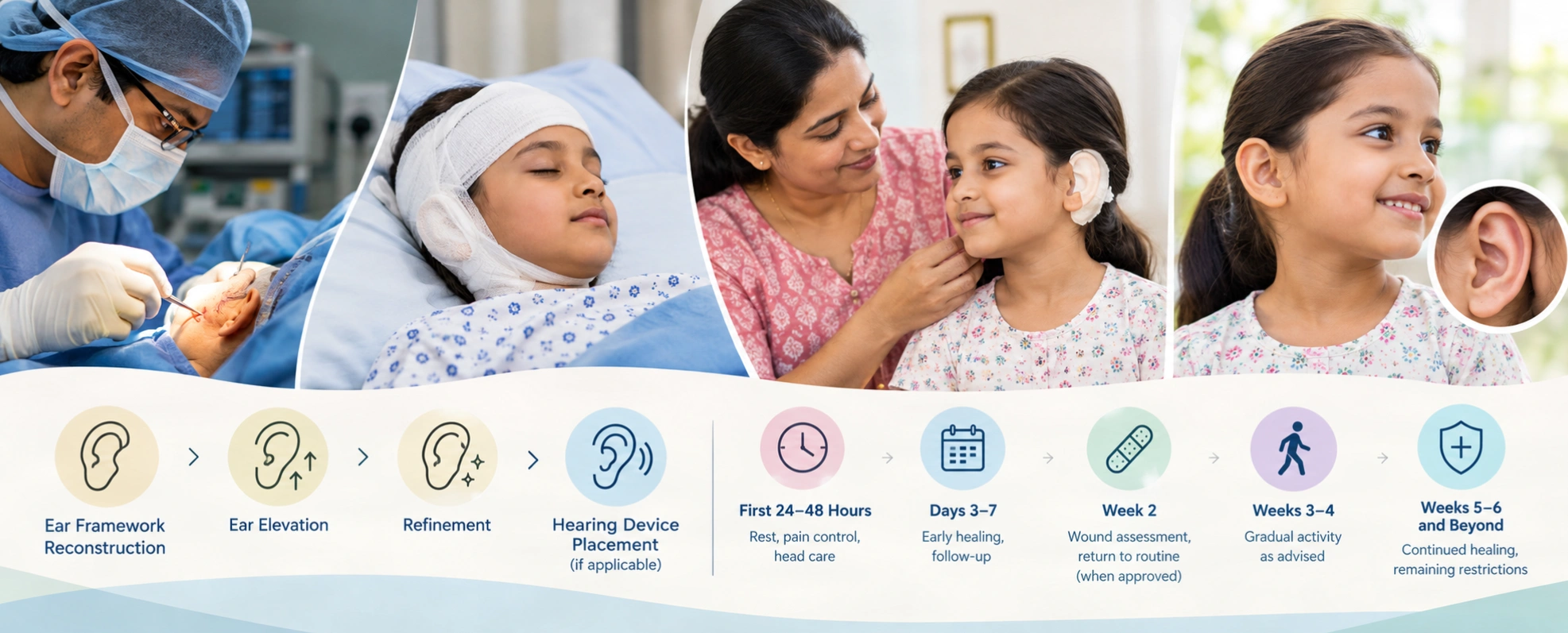
The recovery time for microtia surgery depends on the type of surgery carried out, and the age and general health of the patient. Most children recover well but will need appropriate care and some activity restrictions while the reconstructed ear heals.
Some discomfort, swelling and pain around the operated area are common in the first few days following surgery. Your surgeon may advise you to wear a protective dressing or compression garment depending on the procedure. Young children will need to be supervised to prevent them from touching, rubbing or putting pressure on the ear. Pain relief may be prescribed to help with discomfort, and swelling will generally improve gradually.
Our team will be in close contact throughout the recovery process, and we will schedule follow-up visits to monitor your progress and provide ongoing care. Once the first week is behind you, recovery from microtia reconstruction becomes a long and mostly uneventful arc. The first 24–48 hours after surgery are particularly important for recovery. I am dividing it in two parts – one is stage by stage recovery and week by week recovery.
Some families worry that two surgeries mean two difficult recoveries. Stage 1 is the more involved procedure and includes the complete ear structure. Keep in mind that you should take only prescribed medicine and follow the surgeon’s instructions.
During the first week, your child will be quite uncomfortable. There will be some pain and they will feel a bit tired. They will have a large head dressing covering the area. Pain-killers will be given regularly for the first few days. This will help make them more comfortable. Most doctors recommend putting your child to sleep with their head slightly elevated and avoiding lying on the side of their operation.
Some mild pain or tenderness may persist but can be easily controlled with suitable medication. To protect the reconstructed ear, a dressing or other protective covering may be worn. After rib cartilage reconstruction, chest discomfort should resolve mostly within 2 weeks. Gentle washing of hair is often allowed at this stage. Most children will return to school in 2–3 weeks, depending on their recovery and the surgeon’s advice.
Most children will be back at school. Many will be eager to go back. They will start to regain concentration and stamina but may still be restricted physically. Your child may be able to sit in class for the whole time but may be advised to avoid the playground. Many children will feel more tired in the afternoons. It is often kinder to have a shortened day for the first week. They will be advised to avoid contact sports, wrestling with their siblings, cycling and any sports that may involve hitting the side of their head with a ball or elbow.
The school can be asked to seat your child appropriately. You should ask them to excuse your child from sport for the time your surgeon has advised. They should also be aware of any teasing. Follow your surgeon’s advice about sleeping positions and when it is safe to put pressure on the operated ear. Some children may continue avoiding that side even after the restriction is no longer necessary.
The shape will start to form. The swelling will gradually reduce. You will start to get some good definition of the folds and shadows of the ear. There can be numbness over and behind the ear, which will improve gradually over months. Scars are often most obvious at this stage; they can be pink or darker in colour than the surrounding skin and may feel slightly firm to touch.
A sun protectant and careful treatment of scars can be helpful. Your team may suggest massaging or a special dressing. Usually swimming can be done once wounds have healed completely and your doctor has confirmed it is safe.
The scars will continue to evolve even beyond the time most families stop looking. The redness will fade, and the scar may gradually become softer. The scar may become less noticeable just below your ribs and covered by your clothes. Your ear will continue to improve as the final swelling settles and the skin conforms to the structure underneath. You might consider a small touch up at this stage. The final appearance can take time to develop, so the outcome should be assessed with your surgeon during follow-up visits.
Contact the surgical team on the same day if your child develops increasing pain, spreading redness, discharge, a foul smell from the wound, or if the wound starts to open. You should also contact the team if the skin over the reconstructed ear becomes unusually dark or changes colour, or if your child appears unwell.
If your child has difficulty breathing, severe or worsening chest pain, or becomes unresponsive, seek emergency medical care immediately.
At Dr. Vijay ENT Hospital, follow-up appointments will be arranged before discharge. For concerns during recovery, inquiries can be directed to the on-call team or through WhatsApp, according to the hospital’s contact instructions.
In general, rib cartilage reconstructions are best done between 7 and 10 years old. This is because enough rib cartilage has developed to form an adult framework. Medpor reconstructions can be done from about 3 to 5 years old. The suitable age depends on the child’s individual circumstances and the surgeon’s recommendation.
No. Ear reconstruction is only to recreate the external ear. Hearing problems associated with aural atresia will need to be assessed by an audiologist and an ENT specialist.
Yes. Adults can undergo microtia reconstruction. The principles of reconstruction are the same as in children. Adults can have rib cartilage or Medpor reconstructions, depending on individual suitability.
The aim of reconstruction is to create a natural-looking ear that balances with the other ear. While it will not be identical to a natural ear, most children will have a natural-looking ear, and the final appearance varies from person to person.
Because it is done under general anaesthetic you will not feel anything during the operation. You will, however, feel some pain after the operation. The pain will be manageable and mostly in an unexpected place. Your surgical team will advise you on pain relief.
The lack of outer ear is only a physical difference. The hearing loss can be a disability depending on how severe it is. Children with conductive hearing loss in one ear will often qualify for help in school such as sitting at the front or using a remote microphone. If they have hearing loss in both ears it will be more likely to be recognised as a disability. This will be decided by an audiologist and the appropriate authority.
Usually, yes. The ear canal is narrowed or closed (aural atresia), meaning sound cannot reach the eardrum. The inner ear is usually fine, meaning it is conductive hearing loss. A bone conduction aid can be used to help overcome this problem by vibrating through the skull. Some children are suitable for surgery to open up the canal.

Dr. Vijay Gakhar is a renowned ENT specialist and expert Microtia surgeon in Rajasthan, India. Carrying the MBBS degree from the prestigious SMS Medical College, Jaipur, he holds specialisation with an MS in Otolaryngology ENT (Ear, Nose, and Throat) from Jawaharlal Nehru Medical College (JLN), Ajmer. Besides known for performing the best ear reconstruction surgeries, Dr. Gakhar grabs expertise in all other ENT services such as Septoplasty, Myringoplasty, Nasal Endoscopy, Commando Surgery, and FESS (Functional Endoscopic Sinus Surgery), for over 20 years.