58-59 Balaji Nagar, St Stephen Circle, Makarwali Road, Ajmer, Rajasthan 305004


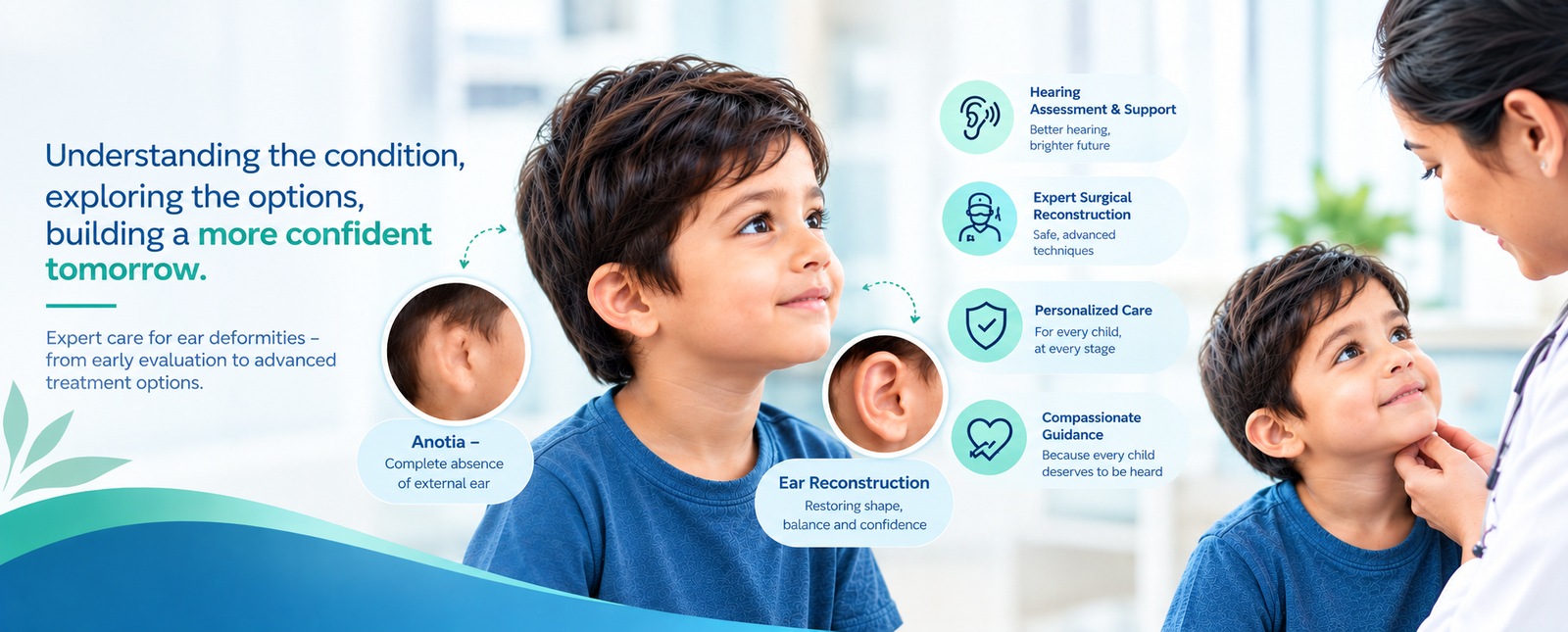
When a baby is born without an external ear parents often have lots of questions. They may want to know why this happened, if the child will be able to hear, when to start treatment and even how to make a new ear.
Above condition is likely known as anotia. It refers to the congenital absence of the outer ear. Sometimes, in addition to the outer ear, the ear canal and related structures that are responsible for hearing are also underdeveloped. The good news is that there are treatment options available.
Based on the child’s age, anatomy and hearing ability as well as the functionality of other systems in the body, hearing support, reconstructive surgery or the creation of a prosthetic ear may be recommended.
This topic covers anotia treatment, anotia surgery, ear reconstruction and missing ear reconstruction.
Anotia is the condition where the external ear is absent or fails to develop. This is the extreme form of microtia, which is a spectrum of deformities that affect the outer ears. In short, Microtia is the term for ears that are smaller than normal or underdeveloped.
With Anotia being the point where the patient has no external ear. Anotia develops during the formation of the baby’s ears in the womb. As such, it is usually diagnosed at the time of birth, with the doctors examining the baby’s ears and checking the ear canals, hearing and other possible issues.
It is vital that the parents speak to the doctor about the child’s hearing and other potential problems. It is vital to rule out hearing problems since there is a possibility that the auditory canal might also be deformed.
The etiology of this disease is not fully elucidated. During the first trimester of pregnancy, the formation of the outer ear occurs and any disturbance during this period can lead to abnormalities in the development of this structure.
The disease can be unilateral or, more rarely, bilateral and can accompany other congenital disorders or occur independently. In this regard, it is especially important to examine each child individually and determine the accompanying pathology, and not just consider the anotia as an isolated change.
Consequently, the doctor should not immediately resort to a particular treatment. if the child has a congenital absence of the external ear since there may be other causes of the disease.
Anotia may be accompanied by hearing problems, if the ear canal and middle-ear structures are also impacted. The hearing capacity, however, is not the same in all children and those born with anotia may have some functional hearing on the affected side due to the normally developed middle ear and the other ear.
As a result, hearing testing is an essential component of the initial assessment and doctors may advise hearing tests that are appropriate for the child’s age and if necessary, counsel them about hearing aids such as bone-conduction hearing devices.
Additionally, they may consider repairing the ear canal in certain instances. It is crucial to note that a hearing aid and an ear reconstruction do not always go together since the latter does not enhance hearing.
Parents may not always need to rush into ear reconstruction surgery. One of the first steps is to understand the condition of the child. An initial evaluation can help doctors learn:
Early hearing tests are important to ensure that the child can hear properly as hearing is vital to communication and development. The published literature shows that clinical professionals recommend comprehensive hearing evaluations for children born with congenital ear deformity. A proper treatment pathway can be designed for the child’s needs rather than the same approach used for all patients.
Anotia treatment depends on what the child needs. There is no such single treatment that is suitable for every case. Treatment may include hearing assessment and support, external ear reconstruction or a prosthetic ear.
If the ear canal or other sound-conducting structures are affected, a child may have conductive hearing loss. Depending on the hearing results, doctors may recommend observation, hearing devices or other appropriate treatment. Bone-conduction hearing systems are one option that may be considered in selected children with conductive hearing problems.
Anotia reconstruction aims to create an external ear with an appropriate shape, position and projection. The reconstructed ear is planned according to the child’s anatomy and the appearance of the opposite ear when only one side is affected. One commonly used approach is to create an ear framework using the child’s own rib cartilage. Another option in selected cases is an alloplastic framework made from a medical-grade material.
A prosthetic ear is another possible option for some patients. Instead of creating an ear using the patient’s own cartilage or an implanted framework, an artificial ear is made to resemble the opposite ear. Depending on the case, a prosthetic ear may be supported by adhesives or an implant-based system. The appropriate option depends on factors such as age, anatomy, medical history and personal preference.
Anotia reconstruction surgery is a procedure performed to construct an external ear. Due to the limited or absent natural ear structure, the reconstructive surgery is complicated and requires extensive planning. During the initial examination, the surgeon considers the location of the ear, facial proportions and symmetry, the quality of the skin, the amount of donor tissue and the opposite ear’s growth pattern. By using this information, the surgeon creates a treatment plan that ideally aligns to the patient’s personality and best fit. Using the patient’s own cartilage, the surgeon sculpts a new framework for the ear during a rib cartilage reconstruction. This cartilage taken from the patient’s chest is molded to the preferred shape and placed under the skin to create the new ear.
Most patients require multiple procedures to complete their ear reconstruction and the timing and placement of each incision must be considered to obtain optimal results. The surgical approach has to be customised to satisfy the requirements of each patient and be reviewed in a private consultation with the best surgeon.
The details of anotia ear reconstruction are dependent upon the selected technique. Using the autologous rib cartilage reconstruction method, a surgeon carves a piece of cartilage from the patient’s own ribs to form the framework of the new ear.
The general procedure may include:
The number and timing of procedures may vary substantially between cases. Other types of reconstruction procedures use a prefabricated medical framework in place of the patient’s rib cartilage and offer alternative advantages, limits, and suitability criteria.
There is no particular age that is good for all children. For children who are undergoing rib cartilage reconstruction, the surgery is usually performed during childhood when there is enough of a rib cartilage to create an appropriate framework. Some medical centers describe reconstruction in the range of approximately 6 to 10 years, but the timing can vary depending on the development of the child and the technique being used.
In addition to this other reconstruction techniques may allow for treatment at a different age. The surgeon should therefore evaluate the child’s physical development, the availability of rib cartilage, the ear anatomy, the hearing status and the selected reconstruction method before recommending a surgical timeline. Parents should not base an age on information they find on the Internet.
A personalized assessment is more useful. So please consult Vijay ENT specialist to take good advice.
There are several ways to approach missing ear reconstruction –
The surgeon utilizes the cartilage found in the child’s own ribs. The cartilage is fashioned into the framework of the external ear. As the material is harvested from the patient’s body it is an established alternative for congenital ear reconstruction. Rib cartilage reconstruction requires surgical planning and may involve more than one stage or suggested by the surgeon.
An alloplastic framework of a medical implant is used instead of cartilage harvested from the patient’s ribs. Porous polyethylene frameworks are one example of an alloplastic option used in selected cases. This method can avoid the necessity of obtaining rib cartilage but involves various considerations and possible risks. The surgeon needs to assess deeply, if the method is appropriate for the specific patient.
A prosthetic ear provides an artificial ear instead of a new ear made of cartilage. It may be considered if a patient has a preference against surgical reconstruction or their particular circumstances make prosthetic option appropriate. The prosthesis is designed to give a natural looking appearance and fit onto the other side of the face.
This is the question many parents ask when they are considering ear reconstruction. The fact that external ear reconstruction primarily restores the shape and form of the ear means that hearing loss is not necessarily an immediate concern. However, if the loss of hearing is due to malformation of the auditory canal or middle ear then hearing tests must be performed.
Based on the results of these tests and the overall evaluation of the child’s condition, a physician may recommend hearing restoration treatment and/or surgery to reconstruct the auditory canal. In addition to the method of restoration, it is also important to determine the timing of such intervention. In some cases the procedure can impact the options available to the patient which is why it is better to consult with an experienced medical team. Both treatments should be considered in order to provide the child with an opportunity to hear clearly.
The terms missing ear surgery, anotia surgery and anotia reconstruction are sometimes used to describe reconstruction of a completely absent external ear.
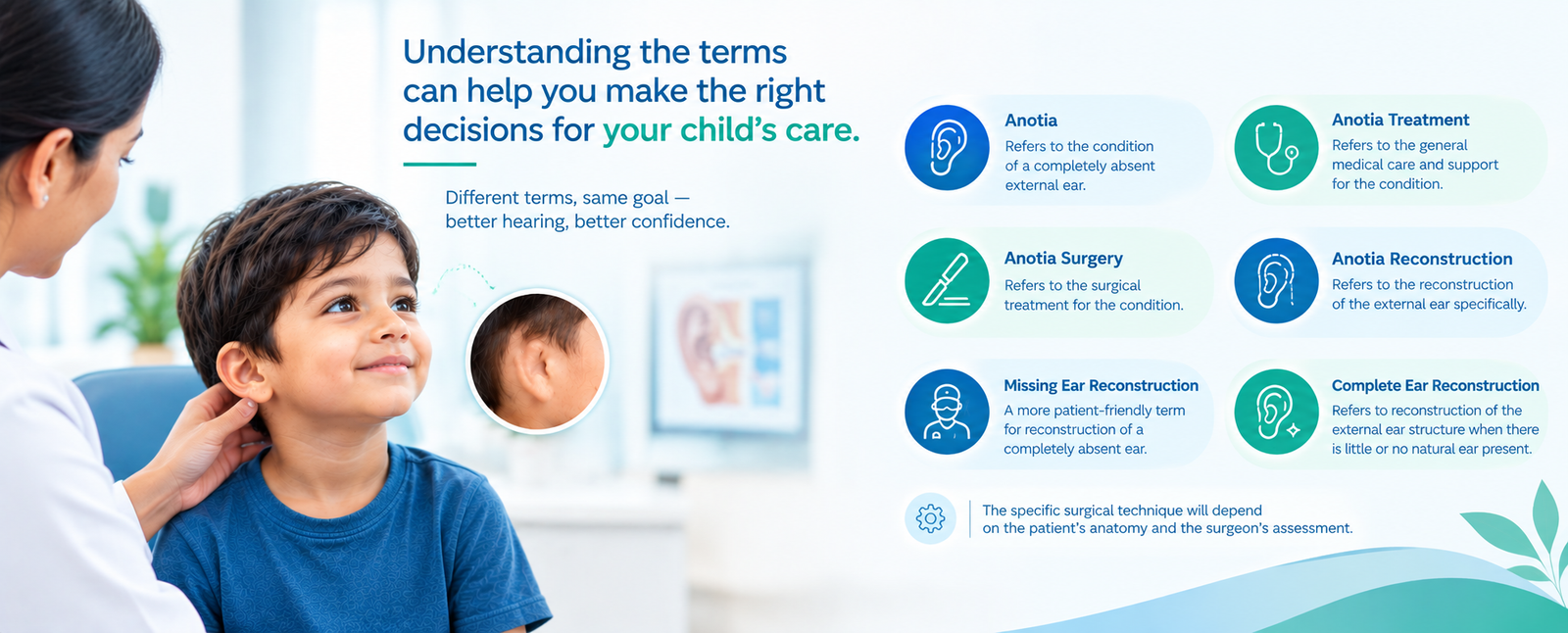
The specific surgical technique will depend on the patient’s anatomy and the surgeon’s assessment.
Choosing an anotia surgeon is an important decision for parents. Ear reconstruction surgery is a complex procedure, as the external ear is made up of many small details and turns and a particular importance is attached to its position on the head.
When looking for a children’s plastic surgeon, it is important to ask the following questions to him:
It is also important to understand the different results that surgery can achieve for different people and please do not compare the child directly with similar kind of photographs found online.
Families seeking anotia surgeons in Jaipur have the option of seeking a personal assessment from a hospital specializing in congenital ear deformities. Dr. Vijay ENT Hospital in Jaipur offers treatment for microtia, ear deformities and ear reconstruction. The hospital official website indicates that they offer various reconstruction methods based on individual assessment. For a child with total absence of the external ear, the initial consultation would involve examining the condition of the ear and discussing options related to hearing and reconstruction. Parents will then be able to identify the suitable course of treatment prior to surgery.
If you are searching for anotia treatment in Jaipur, it is essential to find a center that will consider the child’s ear condition, hearing needs, and reconstructive requirements.
At Dr. Vijay ENT Hospital, Jaipur, treatment options for microtia, ear reconstruction, and congenital ear deformities are discussed. In addition, the hospital provides information on the surgeon’s experience with such treatments as a rib cartilage reconstruction and other approaches. It is critical to understand that every case of anotia is unique, and treatment should be designed during the individual examination rather than based on the information from the web.
Yes, complete ear reconstruction can be performed in children or adults with a completely absent ear.
However, reconstruction does not necessarily mean that the original natural ear is completely reconstructed as it would have been.
The aim is to build up an external ear with an appropriate size, shape, position and projection for the individual’s facial appearance. Various techniques can be used, using either the patient’s own rib cartilage, an alloplastic framework or a prosthetic ear; the choice of technique will depend on the individual case.
Depending on the number and nature of the procedures, ear reconstruction surgery has different post-operative courses. After the procedure, the reconstructed ear must be protected to help the healing process.
The surgeon will give instructions for recovering after the surgery, as well as recommendations on how to sleep, what exercises to avoid, how to care for the incision site and what dressings to change. Parents who have had reconstructive surgery must diligently adhere to the surgeon’s post-operative guidelines and attend all scheduled medical check-ups on-time.
They should also contact their doctor if they experience unusual discomfort, redness, or swelling, fluid discharge from the surgical site, a fever or intense pain or any other unexpected side effects. The healing / rehabilitation period should be viewed by parents as an integral part of the treatment, not as an accompanying event to surgery.
Parents of a child born with complete absence of the external ear, or a major congenital ear difference, should consider seeking the advice of an anotia specialist at the earliest opportunity. An anotia specialist can help with all aspects of the condition including:
Seeking specialist advice at the earliest opportunity does not mean surgery will be required. It simply means the parents can be advised what to expect and can prepare themselves for the next steps.
Anotia is a congenital disorder characterized by the total absence of the external ear. The condition is also referred to as the most severe form of microtia.
Yes. The condition is treatable in various stages depending on the child’s needs. The treatment may involve hearing restoration, ear reconstruction or prostheses.
Anotia surgery is a surgical procedure involving the reconstruction of the external ear.
The reconstruction of an absent ear using one’s own tissue is considered the gold standard. It is achieved by carving a cartilage scaffold from the patient’s sixth or seventh rib. However, other alternative methods include alloplastic framework and prosthetic ears.
No. Hearing can vary from child to child, however hearing should be evaluated as anotia can present with associated conductive hearing loss due to dysgenesis of the ear canal or other sound transmitting structures.
Depending on the reconstructive modality being considered, ear reconstruction using cartilage from the patient’s own ribs is often considered during childhood when adequate cartilage is present; however the timing of surgery should be determined in consultation with your treating specialist.
Not by itself. External ear reconstruction alone does not restore hearing. Hearing evaluation and treatment, if required is considered separately.
Yes. Autologous cartilage from the patient’s own ribs is an established modality for external ear framework reconstruction in selected cases.
Yes. Patients can consult an ENT and ear reconstruction specialist (Dr. Vijay Gakhar) at Jaipur to assess hearing and evaluate possible reconstruction.
Seek out an ENT and ear reconstruction surgeon with expertise and experience in managing congenital ear deformities. In consultation you can discuss the possible treatment options, staging of procedures, evaluation of hearing, post operative course and follow up.
Anotia can be challenging for parents to deal with because when they look at their child, they see a total absence of the external ear. However there is a step-by-step treatment plan that can restore a child’s confidence and self-esteem. The first step is a thorough examination to see if the child has normal hearing and overall ear function. Next, you should consult a craniofacial team with experience in pediatric reconstructive surgery and consider your options.
The reconstruction of the ear is a very intricate procedure, and the options available to you will be dependent on your child’s physical characteristics, age, degree of hearing loss, and overall health. If you notice that your child has Anotia, you should schedule an appointment with a specialist to go over your treatment options and help you develop a treatment plan that is right for your child.
The information provided on this article is for general education purposes only. It is not intended to replace a consultation with a qualified healthcare professional or to serve as a substitute for medical diagnosis or treatment. Patients should not rely on the information provided in this article in order to make any treatment decisions. All patients considering treatment must seek the advice and guidance of a qualified doctor or surgeon.

Dr. Vijay Gakhar is a renowned ENT specialist and expert Microtia surgeon in Rajasthan, India. Carrying the MBBS degree from the prestigious SMS Medical College, Jaipur, he holds specialisation with an MS in Otolaryngology ENT (Ear, Nose, and Throat) from Jawaharlal Nehru Medical College (JLN), Ajmer. Besides known for performing the best ear reconstruction surgeries, Dr. Gakhar grabs expertise in all other ENT services such as Septoplasty, Myringoplasty, Nasal Endoscopy, Commando Surgery, and FESS (Functional Endoscopic Sinus Surgery), for over 20 years.