58-59 Balaji Nagar, St Stephen Circle, Makarwali Road, Ajmer, Rajasthan 305004


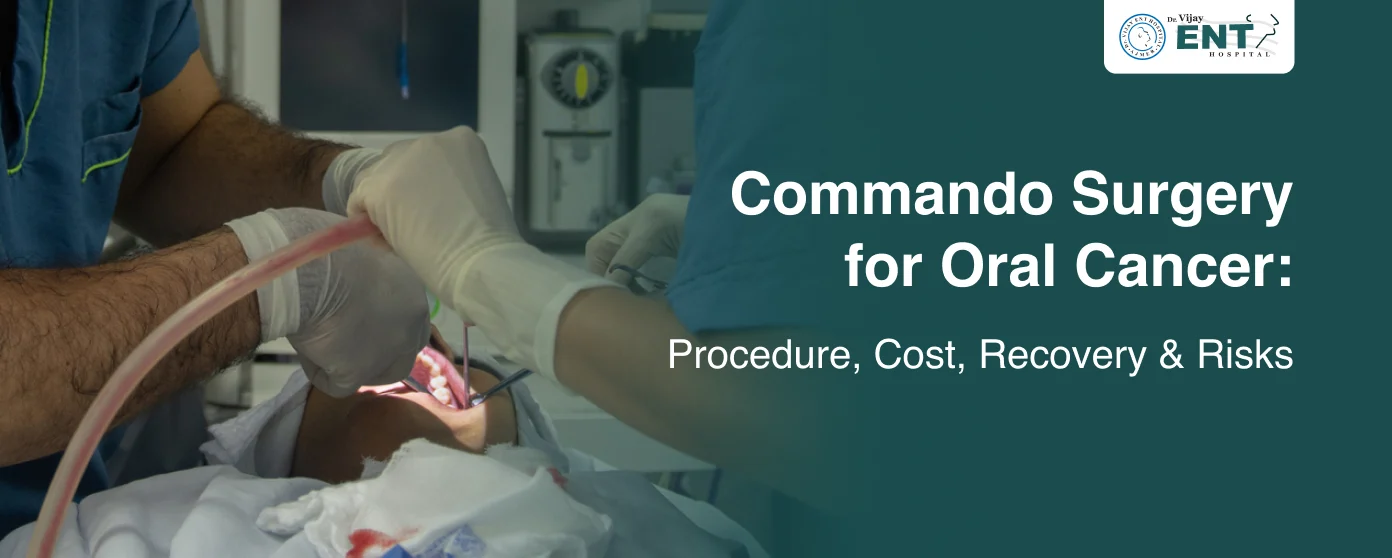
Commando surgery refers to a specialised method or procedure to treat advanced oral cavity cancers, especially those affecting the tongue, floor of the mouth, buccal mucosa, and jaw. It is named ‘Commando’ because of its aggressive and comprehensive nature to primarily remove the tumour, a portion of the jawbone, and the lymph nodes of the neck in a single session, aiming for complete elimination of the cancerous tissue.
The term ‘commando’, derived from composite resection + mandibular resection + neck dissection, reflects the multicomponent nature of the procedure. This surgery is usually recommended to patients with oral squamous cell carcinoma (OSCC) because it is a highly effective surgical approach.
Commando surgery is mainly performed to treat advanced cancers of the tongue, cheek, and mouth. There are detailed points, showcasing why it is performed:
This is the surgical procedure to remove the cancerous tumour, which commonly involves the part of the tongue, buccal mucosa, or floor of the mouth.
In case the cancer spreads to the jawbone, then the part of the lower jaw has been removed. It is of 2 types:
Lymph nodes are removed to prevent the spread of cancer. If nearby structures, such as muscles, veins, or nerves, are also affected, they may also be removed.
After a successful surgery, the rebuilding procedure is performed to help with eating, speaking, or oral function.
Commando surgery isn’t the first-line treatment for every head, neck, and oral cancer. It’s only recommended in certain stages when the cancer has advanced and involves multiple structures. Here are the conditions and circumstances when it’s necessary:
The most common condition is oral cavity cancer, where commando surgery is necessary. When the cancer gets advanced and gradually involves the tongue, floor of the mouth, or inner cheek (buccal mucosa). In such cases, mandibulectomy is crucial to perform, ensuring complete removal with clean margins. Along with this, the lymph nodes are also removed to prevent spreading.
For initial treatment, radiation or chemotherapy is recommended for inoperable tumours and to shrink them. However, when the cancer comes back or persists, the surgery becomes necessary and is often required for effective control.
In some cases, cancer has spread to the lymph nodes in the neck. It is called a neck dissection surgery to remove those nodes, preventing further spread. If it is combined with a primary tumour that involves the jaw and surrounding structures, then a complete commando will be crucial.
Squamous cell carcinoma of the tongue, mandible, and buccal mucosa is the most aggressive and common type of oral cancer. It mainly affects the tongue, inner cheek, and lower jaw, and often spreads gradually to the lymph nodes. When both SCC and lymph nodes are involved, commando surgery is necessary to treat both at once.
The commando surgery procedure includes various aspects from pre-operative preparation to reconstruction. Let’s discuss the procedure in detail:
At the beginning of the surgery, the patient was given antibiotics and anaesthesia to reduce the risk of infection and make the surgery pain-free. Then, healthcare providers may ask you to lie on your back so that they can clean your face, neck, and chest to minimise the risk of surgical site infection.
To access the jaw and tongue completely, the surgeons make a ‘U’ or ‘Y’ shape incision on the neck, extending from the neck to the lower lip or chin.
In the neck structure, the surgeon/doctor cleans the lymph nodes from both sides of the neck, preventing cancer from spreading. Additionally, if the cancer invaded the nearby muscles, then the doctor may also remove the internal jugular veins or those muscles.
The portion of the jawbone containing the tumour is removed. If the cancer has spread deeply, the entire jawbone is removed. However, if the bone is in normal condition, the upper edge of the jawbone is removed.
The surgical procedure to remove the primary tumour of the tongue (the part or the full tongue), the floor of the mouth, and the cheek. This is performed to treat advanced tongue cancer.
When commando surgery is performed, it will leave a gap in the surgical area. To fill that gap, rebuilding surgery is executed, filling the gap by removing bone and soft tissue. Reconstruction surgery is also 2 types:
After all the main procedures and surgical aspects, a temporary breathing tube is inserted through a small hole in the neck to prevent swelling blockage in the airways. Also, as surgery was performed in the mouth, patients may not be able to consume enough nutrition orally, so a nasogastric (NG) tube is usually inserted to provide nutrition while the mouth heals. In case of fluids, drains were placed in the neck to remove them and to prevent infections.
At last, the surgical incision on the neck and lip/chin has been closed with the suturing process.
The commando surgery cost isn’t fixed; it depends on various factors, including hospital type, surgeon experience, cancer type, and locality. However, to know the estimated amount, here is the table, showcasing the average cost.
| Component | Estimated Cost (INR) | Description |
| Basic Commando Surgery | ₹60,000 – ₹1,20,000 | Basic excision + neck dissection |
| With Local Flap Reconstruction | ₹2,50,000 – ₹3,75,000 | Involves tissue from nearby areas |
| With Free Flap Reconstruction | ₹4,50,000 – ₹5,50,000 | Complex microvascular reconstruction |
| Pre-operative Diagnostics | ₹10,000 – ₹25,000 | CT/MRI, Biopsy, Blood tests |
| Hospital Stay (ICU/Room) | ₹20,000 – ₹50,000+ | Varies by duration and room type |
| Surgeon/Anaesthesia Fees | ₹30,000 – ₹1,00,000+ | Depends on the surgeon’s expertise |
Commando surgery is a complex surgery used to treat advanced oral cancer. However, due to its invasive nature, it can carry some risks and complications. Let’s discuss these for future surgical planning:
You may experience difficulty speaking or swallowing after Commando surgery. This is common, but speech and swallowing therapy are essential for quick improvement. Many patients may experience difficulty or pain while swallowing after surgery. Understanding the causes of throat pain during swallowing can help patients identify symptoms early.
The commando surgery involves the removal of blood vessels and the operation near vascularized areas. Due to this, bleeding is common and usually occurs.
Our mouth is full of bacteria, and when commando surgery is performed, the mouth is combined with the neck incision, which increases the chances of infection. To prevent this, you need to take long-term antibiotic treatment.
During reconstructive surgery, the surgeon uses microsurgery to connect the blood vessels to the neck. But when blood clots develop in these vessels, the transplant may fail.
When removing lymph nodes, crucial nerves that control facial movement and sensation may be damaged. This leads to numbness of the lower lip, chin, or tongue.
Commando surgery is the procedure that takes weeks or months to recover from. Moreover, precise care is also required to ensure proper healing. Here are the stages of recovery:
Instead of facing recurrent oral cavities, tongues, and jawbone cancer, it will be better to undergo commando surgery. It has various benefits, including:
With commando surgery, the primary tumour has been removed, involving the bone (mandible) and nearby lymph nodes in a single session.
Along with the neck dissection, surgeons also address potential/advanced cancer spread to lymph nodes. This reduces the chances of recurrence.
Functional and aesthetic reconstruction can also be performed in the same surgery, helping patients to restore speech, swallowing, and facial appearance.
Commando surgery is the specialised approach to treating oral cavity cancers. This surgery is performed by expert ENT (Ear, Nose, Throat) surgeons and experienced doctors. If you feel any of the following symptoms, then you must consult with them:
Persistent mouth ulcers, swallowing difficulty, voice changes, and oral pain should never be ignored. These symptoms may indicate serious ENT or oral conditions that require evaluation by a specialist. You can also read about other warning signs that indicate you should visit an ENT specialist.
Commando surgery isn’t just a surgical treatment for oral cavity cancer, but also a lifesaving treatment that combines extensive resection of the primary tumour, mandibulectomy, and neck dissection. Because it is a specialised surgical approach, you need expert ENT surgeons with years of experience. They can help you with better treatment and quicker healing.
| This article is for informational purposes only and should not replace medical advice. Please consult a qualified ENT specialist for diagnosis and treatment. |

Dr. Vijay Gakhar is a renowned ENT specialist and expert Microtia surgeon in Rajasthan, India. Carrying the MBBS degree from the prestigious SMS Medical College, Jaipur, he holds specialisation with an MS in Otolaryngology ENT (Ear, Nose, and Throat) from Jawaharlal Nehru Medical College (JLN), Ajmer. Besides known for performing the best ear reconstruction surgeries, Dr. Gakhar grabs expertise in all other ENT services such as Septoplasty, Myringoplasty, Nasal Endoscopy, Commando Surgery, and FESS (Functional Endoscopic Sinus Surgery), for over 20 years.