58-59 Balaji Nagar, St Stephen Circle, Makarwali Road, Ajmer, Rajasthan 305004

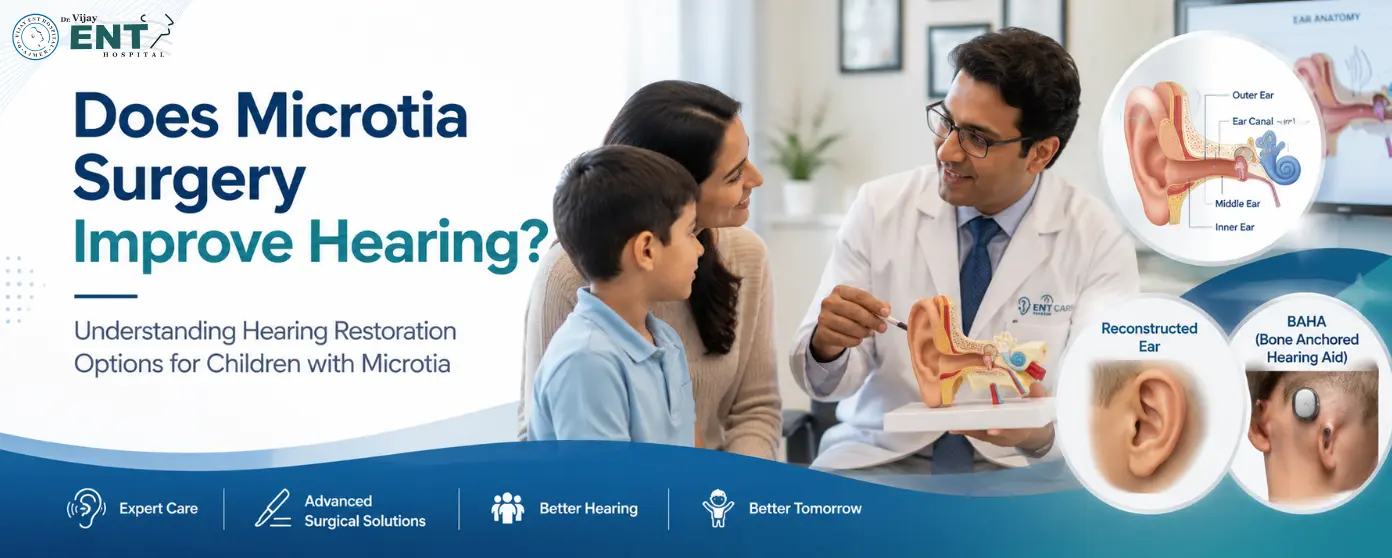
Parents of children with microtia often wonder whether surgery can help improve their child’s hearing. The answer is that microtia reconstruction surgery primarily restores the appearance of the outer ear, while hearing improvement usually depends on additional procedures such as canalplasty or bone-conduction hearing devices. Understanding how microtia affects hearing and the available microtia treatment options can help families make informed decisions about their child’s care.
Microtia is a congenital ear deformity in which the outer ear is abnormally shaped. To better understand the condition, read about the causes, symptoms, and treatment of microtia. In many children with microtia, the ear canal may be narrowed, underdeveloped, or completely absent (aural atresia). As a result, sound cannot travel efficiently to the middle and inner ear, leading to conductive hearing loss.
Outer Ear Part: On the outside of the ear, the pinna (soft cartilage structure) is present, which directs sound waves to the ear canal.
Middle Ear Part: When sound waves hit the eardrum, it produces vibrations, which are immediately transmitted to the three smallest bones (ossicles).
Inner Ear Part: Ossicles push on the cochlea (inner ear), which converts the vibrations into electrical signals and transfers them to the brain.
Microtia has a significant impact on the normal functioning of the ear. The inner and outer ear develop at different times during pregnancy, resulting in the inner ear (in most cases) being fully developed, but the connecting passages being affected.
Microtia often occurs in the vicinity of aural atresia, which causes the ear canal to become narrowed, completely blocked, or completely absent. Because of this abnormal ear canal, sound waves cannot physically reach the eardrum.
The middle ear bones (malleus, incus, and stapes) that play a crucial role in passing sound to the inner ear may also be smaller and not properly formed.
Due to these issues, it results in conductive hearing loss because the paths that route the sound are blocked or broken.
Microtia reconstruction surgery focuses on rebuilding the outer ear and improving its appearance. While this procedure alone does not typically restore hearing, many patients can achieve significant hearing improvement through additional treatments such as canalplasty or bone-conduction hearing devices.
This is how it can be restored:
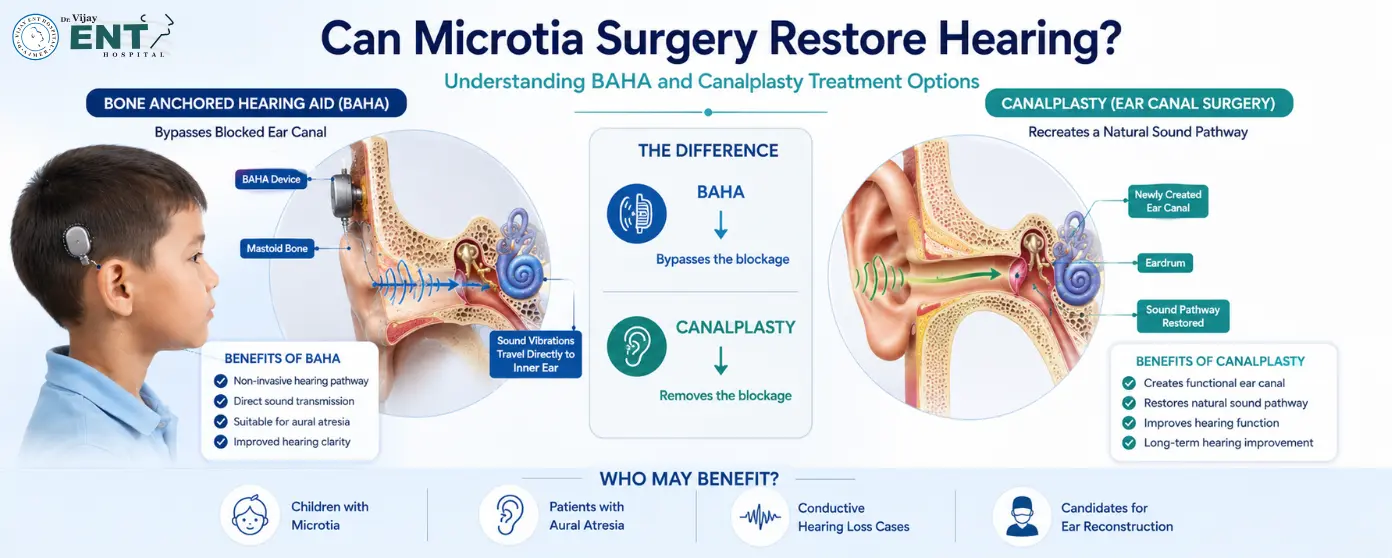
Because the inner ear usually functions normally, doctors use two main approaches to help sound bypass or overcome the blocked ear canal.
Doctors place devices such as BAHA (Bone Anchored Hearing Aid) on or within the mastoid bone located directly behind the ear. These devices can capture sound waves and send them in the form of vibration into the healthy inner ear, bypassing the blocked ear canal.
This is the surgical method in which the ENT surgeon drills a new and functional ear canal and creates a new eardrum. With this natural process, the sound can be transmitted easily into the ear.
Patients usually undergo a combination of surgeries to achieve both cosmetic and hearing goals:
The timing of reconstruction is important, and parents often ask about the best age for microtia surgery. Doctors use either the patient’s own rib cartilage or a synthetic material (like Medpor) in the reconstruction process.
If the child meets the medical requirements, then the surgeon will perform canalplasty surgery. The decision depends on the child’s anatomy and evaluation by a microtia specialist. If not, then surgeons may implant a bone conduction device during reconstruction surgery.
A BAHA (Bone-Anchored Hearing Aid) device bypasses the blocked ear canal and delivers sound directly to the inner ear, helping patients hear more clearly without relying on the natural ear canal. This allows you to hear sounds clearly and immediately without having to open the ear canal.
Surgery such as canalplasty (creating a new eardrum and ear canal) may restore natural hearing, allowing the ear to receive sound waves like a normal ear.
Improved hearing and ear reconstruction can help children communicate more effectively, participate confidently in social activities, and enhance their overall quality of life.
Children born with microtia should undergo an early hearing evaluation to determine the extent of hearing loss and identify suitable treatment options. A specialist can assess whether the child is a candidate for microtia reconstruction, canalplasty, or bone-conduction hearing devices. Early intervention can support speech development, communication skills, and overall quality of life. Families should also understand the different types of ear deformities that may affect treatment planning.
Microtia reconstruction surgery is designed primarily to restore the appearance of the outer ear and does not directly correct hearing loss. However, procedures such as canalplasty and bone-conduction hearing devices can help improve hearing in many patients. A comprehensive evaluation by an experienced microtia specialist is essential to determine the most suitable treatment plan for each child.
If your child has microtia or associated hearing loss, consult Dr Vijay ENT to explore reconstruction and hearing restoration options tailored to your child’s needs.
Microtia reconstruction improves the appearance of the outer ear, but hearing improvement usually requires additional procedures such as canalplasty or bone-conduction hearing devices.
Many children with microtia have normal inner ear function. With appropriate treatment, hearing can often be significantly improved.
Canalplasty is a surgical procedure that creates or widens the ear canal, allowing sound to reach the eardrum more effectively.
A Bone Anchored Hearing Aid (BAHA) bypasses the outer and middle ear and transmits sound vibrations directly to the inner ear.
The timing depends on the surgical technique used and the child’s development. A specialist can recommend the most appropriate age for treatment.

Dr. Vijay Gakhar is a renowned ENT specialist and expert Microtia surgeon in Rajasthan, India. Carrying the MBBS degree from the prestigious SMS Medical College, Jaipur, he holds specialisation with an MS in Otolaryngology ENT (Ear, Nose, and Throat) from Jawaharlal Nehru Medical College (JLN), Ajmer. Besides known for performing the best ear reconstruction surgeries, Dr. Gakhar grabs expertise in all other ENT services such as Septoplasty, Myringoplasty, Nasal Endoscopy, Commando Surgery, and FESS (Functional Endoscopic Sinus Surgery), for over 20 years.