58-59 Balaji Nagar, St Stephen Circle, Makarwali Road, Ajmer, Rajasthan 305004

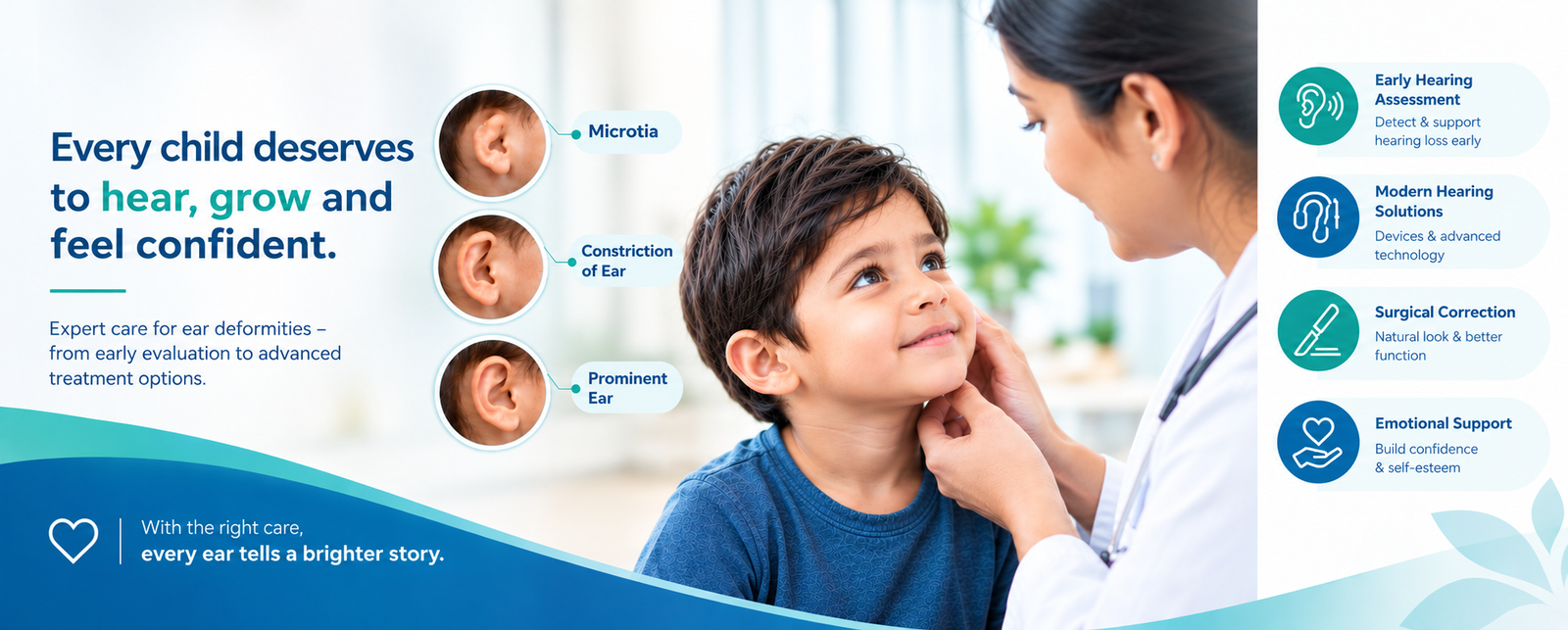
When a child is born with an atypical ear shape, size or position, parents are rightly concerned about the appearance and hearing of child. An ear deformity refers to a group of conditions, which may be present at birth or rarely occur as a result of an injury. Microtia is one of the better-known conditions, but there are other variants. Most ear deformities can be corrected successfully with timely management and appropriate precautions with modern treatment options. Now let me explain what you need to know about ear deformity, the precautions you can take and the treatment and surgical options that are available to address ear deformity.
The term ear deformity covers any deviation from the normal appearance of the external ear (the pinna) that may occur at birth or as a result of an injury. Congenital ear deformities occur during the early weeks of pregnancy as the ear structures develop. The most common type is microtia where the external ear is underdeveloped, and may range from mild to complete absence (anotia).
Other congenital forms include constricted ear, Stahl’s ear, cryptotia and prominent ears. Acquired ear deformities may be caused by trauma or burn. Many children with a congenital ear deformity have normal inner ear functions normally but incomplete ears or ear canal may be incomplete, resulting in conductive hearing loss. Ear deformity is relatively uncommon. Microtia occurs in roughly 1 in every 5,000 to 10,000 births. It is more often seen in boys and frequently involves one ear rather than both.
The impact of an ear deformity depends on its severity. These abnormalities range from mild to moderate with little functional implications. Severe deformities may cause-
Early hearing tests are crucial to establish the extent of hearing loss and provide appropriate auditory intervention. Many children with malformed ears have normal inner ear function and can derive tremendous benefit from hearing assistance devices.
There are certain practical steps that can help protect hearing, support development and prepare for any future treatment.
These measures alone won’t provide adequate care, but they’re an essential foundation for healthy development and treatment.
Treatment is planned according to the type and severity of the deformity, the child’s age, hearing status and family preferences. The approach may be non-surgical or surgical.
Non-Surgical Options
Surgery is typically performed to achieve both cosmetic and, when possible, functional restoration. The timing of the procedure is critical to consider. Most reconstructive procedures are performed when the child is between six and ten years old, once the ear has reached near-adult size and enough rib cartilage is available if needed.
Common surgical approaches include:
The choice of procedure is individualized based on anatomical considerations, surgeon experience, and family desires. An experienced ear deformity surgeon can discuss the relative benefits, downtime and expected results of each procedure.
Parents should consult a specialist immediately an ear difference is noticed. Ideal steps include:
Choosing a surgeon who regularly performs ear deformity correction surgery improves the likelihood of natural-looking results and coordinated care.
Dr. Vijay Gakhar at Vijay ENT Hospital in Ajmer is widely known for his work in microtia and other ear deformities. With extensive experience in both traditional (rib cartilage) and contemporary approaches to ear reconstruction, I offer comprehensive reconstructive care to restore both form and function to patients with ear deformities. Lots of families across India are referred to me for my specialized expertise in their respective cases, giving me the opportunity to offer a personalized and nuanced approach to each scenario.
Ear deformity, whether mild or complicated, does not have to limit a child’s development or confidence. Early audiologic evaluation, combined with cautious parental management and reconstructive interventions such as modern hearing aids and surgery when appropriate, can yield amazing results.
The most critical step in the management of an ear deformity is consulting with an experienced ear deformity surgeon who is familiar with the functional and cosmetic implications of the condition. With the proper guidance, most children can grow up with confidence regarding their ear appearance and hearing capabilities. If your child is diagnosed with an ear deformity, or if you have further questions about their treatment options, I encourage you to schedule a consultative discussion with a qualified surgeon.
What causes congenital ear deformity?
Most cases arise during early pregnancy as the ear structures develop. In many cases, the causes of this medical condition are unknown, but genetic predispositions as well as some environmental factors may play a role.
Is it possible to correct ear deformity without surgery?
In some cases, minor abnormalities or certain types of malformation can be managed with early molding or managed with hearing aids and prostheses, but more severe cases require reconstructive surgery.
At what age is ear deformity surgery usually performed?
Reconstructive procedures are commonly planned between six and ten years of age. Hearing support can begin much earlier.
Does deformed ear surgery restore hearing?
Surgery primarily improves the appearance of the outer ear. Hearing improvement usually requires separate measures such as bone-conduction devices or, in selected cases, canalplasty.
Is rib-cartilage ear reconstruction safe?
Ear surgery for deformity is a common procedure that is associated with excellent outcomes when performed by an experienced surgeon. In most cases, the donor area on the chest is highly predictable and heals well.
What should parents consider when selecting a surgeon to correct ear deformity?
The parents should look for a specialist who is able to perform this type of surgery on a regular basis, demonstrate proven results, work closely with audiologists and be able to explain the treatment plan.

Dr. Vijay Gakhar is a renowned ENT specialist and expert Microtia surgeon in Rajasthan, India. Carrying the MBBS degree from the prestigious SMS Medical College, Jaipur, he holds specialisation with an MS in Otolaryngology ENT (Ear, Nose, and Throat) from Jawaharlal Nehru Medical College (JLN), Ajmer. Besides known for performing the best ear reconstruction surgeries, Dr. Gakhar grabs expertise in all other ENT services such as Septoplasty, Myringoplasty, Nasal Endoscopy, Commando Surgery, and FESS (Functional Endoscopic Sinus Surgery), for over 20 years.