58-59 Balaji Nagar, St Stephen Circle, Makarwali Road, Ajmer, Rajasthan 305004


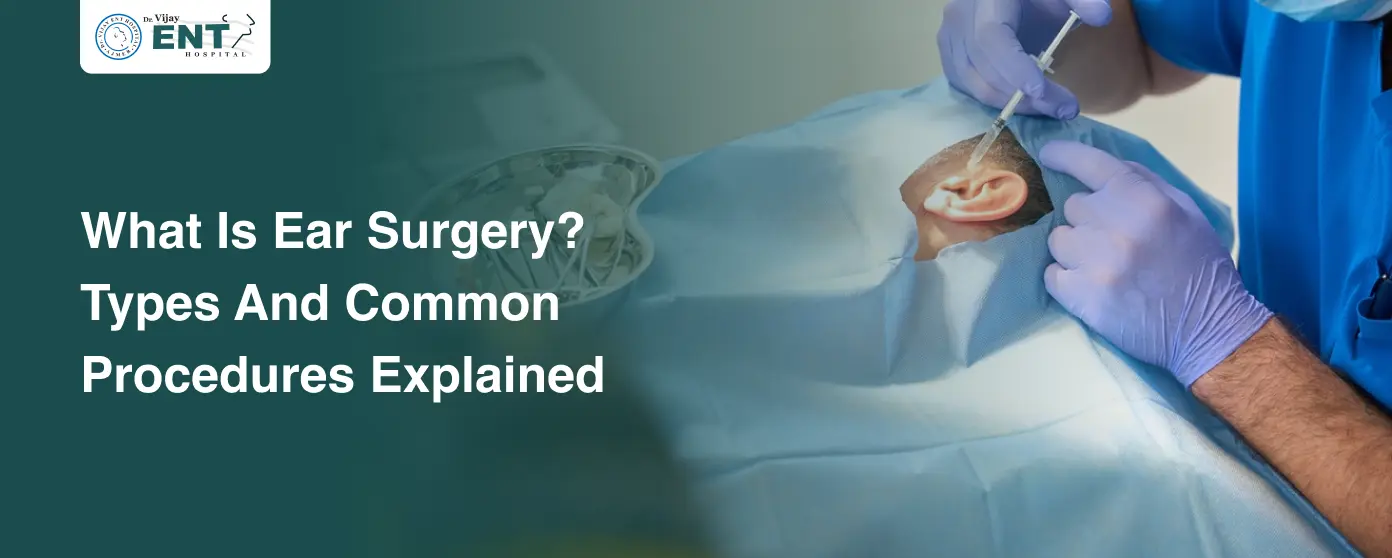
Ear disorders are quite common these days. You might have seen many adults or kids around you suffering from ear problems that severely affect their hearing, balance, appearance, and self-confidence. Some ear conditions, such as Microtia, Chronic Otitis Media, Perforated Eardrum, and many more, may require surgical treatment when medicines or observation are not enough.
These types of ear conditions affect everything from hearing to self-confidence. While dealing with these deformities, the initial stage is medications, but some conditions need a specialized approach. Ear surgery is a transformative method to repair structural damage, treat chronic infections, and improve hearing.
In this blog, we will understand what ear surgery exactly is, and what its types and procedures are.
Ear surgery is a medical procedure performed to improve the structure, function, or appearance of the ear. The surgery is often performed to treat protruding, prominent ears, and functional surgeries too.
Ear surgery is needed in case of structural or functional issues like hearing or an underdeveloped ear that cannot be treated with medications. Here is the key reason for ear surgery:
Ear surgery is recommended when medical treatments fail to resolve structural or functional ear problems.
Ear surgeries are of several types; some improve hearing, while others repair ear bones. Let’s discuss every type in a detailed version:
Tympanoplasty is a surgical procedure to reconstruct or repair the perforated eardrum (tympanic membrane). The main purpose of this surgery is to fix a torn eardrum caused by ear infection, trauma, or loud noise. It is performed when the eardrum fails to heal on its own, and infection is spreading, or pain gets intense.
In the procedure of this surgery, the ENT surgeon uses a patient’s own graft taken from tissue (cartilage) to heal or repair the hole. The goal is to restore the integrity of the eardrum and prevent it from further infection.
In microtia, the outer part of the ear is underdeveloped, with different shapes and small sizes. To treat or reconstruct this, microtia surgery is performed. Generally, it is performed in children, in which surgeons use a child’s own rib cartilage to build a realistic ear framework. This is usually done at young ages, 6 to 10, and has 4 stages of completion. The main objective of this surgery is to remove the deformed cartilage and build a new framework with new ear lobes to achieve a realistic appearance.
Myringotomy is a common procedure in children used to treat chronic ear infections or persistent fluid buildup in the middle ear canal. Basically, this is a procedure to drain the existing fluid, where antibiotics cannot effectively reach and drain the fluid.
In this surgical process, the surgeon makes a tiny incision in the eardrum. Through this incision, the existing fluid or pus comes out. Moreover, in some cases, a tiny ventilation tube may be placed. The open hole allows the ear to stay ventilated and equalise pressure.
Mastoidectomy is a surgical process to remove the infected air cells from the mastoid bone (present behind the ear and at the base of the skull). This surgery is mainly used to treat cholesteatoma (an abnormal skin growth) or chronic mastoiditis (a persistent bacterial infection) that has not been cured with medications.
In this surgical procedure, the surgeon makes a cut behind the ear to access the mastoid bone. With the help of a surgical microscope and a drill, the surgeon removes the infected bone tissue. If there is cholesteatoma present, then it is also removed along with any diseased mastoid air cells. The main goal of this surgery is to remove the infection and prevent it from spreading to the skull, inner ear, or surrounding bone.
Otoplasty is a cosmetic or reconstructive procedure used to change the position, appearance, and size of the outer ear (pinna). The other names of Otoplasty are ear pinning or reshaping.
During surgery, the surgeon makes a tiny incision behind the ear to access the cartilage to reshape, reduce, or reposition it closer to the head. In many cases, the extra cartilage skin is removed to give the desired shape. The main goal of this surgery is to fix prominent ears and improve symmetry.
Every ear surgery has different processes and indications, and its recovery is based on the performed incisions and methods implemented. Here is the recovery process of common ear surgeries:
Microtia surgery is outer ear reconstruction, which needs proper care and treatment:
You should not blow your nose, as it may put pressure on your ear, causing pain and severe problems.
Ear deformities are now common in the world, and there are many surgeries available to treat those deformities. If you experience chronic ear infection, mild pain, sudden hearing loss, and constant vertigo, then you must consult a professional ENT specialist. They check your ear carefully, and if anything like ruptured eardrums, fluid buildup, cholesteatoma, or otosclerosis is detected, then they may perform ear surgery.
Ear surgery isn’t just a surgical procedure to treat underdeveloped or infected ears; it is also a path that develops confidence and improves hearing in patients. If you or anyone you know is suffering from ear problems like persistent infection, severe dizziness, injury, or blood drainage, then you need to consult a specialist ENT surgeon. The surgeon helps treat your ear efficiently with medications and specialized surgeries like Microtia surgery or Tympanoplasty.
Ear surgery is a medical procedure used to treat structural, functional, or cosmetic issues of the ear, including hearing loss, infections, and deformities.
Ear surgery is required when conditions like chronic infections, eardrum perforation, hearing loss, or congenital deformities cannot be treated with medications.
Ear surgery is performed under anesthesia, so patients do not feel pain during the procedure. Mild discomfort after surgery can be managed with prescribed medications.
Common types of ear surgery include tympanoplasty, microtia surgery, myringotomy, mastoidectomy, and otoplasty, each designed to treat specific ear conditions.
Recovery time depends on the type of ear surgery, but most patients can return to normal activities within 1 to 3 weeks, while full healing may take a few months.
Yes, ear surgery is generally safe when performed by an experienced ENT specialist, with minimal risks and high success rates.

Dr. Vijay Gakhar is a renowned ENT specialist and expert Microtia surgeon in Rajasthan, India. Carrying the MBBS degree from the prestigious SMS Medical College, Jaipur, he holds specialisation with an MS in Otolaryngology ENT (Ear, Nose, and Throat) from Jawaharlal Nehru Medical College (JLN), Ajmer. Besides known for performing the best ear reconstruction surgeries, Dr. Gakhar grabs expertise in all other ENT services such as Septoplasty, Myringoplasty, Nasal Endoscopy, Commando Surgery, and FESS (Functional Endoscopic Sinus Surgery), for over 20 years.