58-59 Balaji Nagar, St Stephen Circle, Makarwali Road, Ajmer, Rajasthan 305004


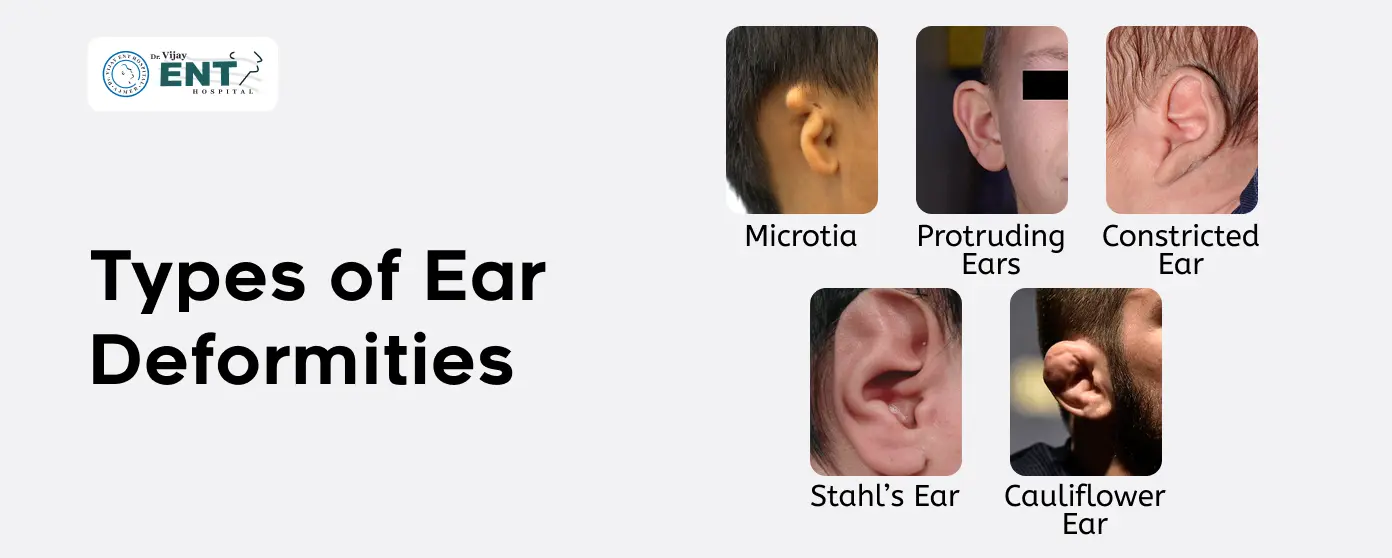
Ear deformities are more common than people think. Nowadays, children or even adults are suffering from this condition. However, some are dealing with microtia, while others are dealing with anotia. So, there is no single common ear deformity of the ear. There are many types of ear deformities; some are congenital, and some develop after birth due to injuries. Children or adults with these kinds of problems have to face many issues, such as fear of judgment, lack of acceptance, and rejection in relationships.
However, ear deformities are nothing to be afraid of, as with the growing technology, there are many treatments available for it. You just need to find the right treatment option and the best ENT specialist to cure it efficiently. In this blog, you will understand the types, causes, and treatment options for ear deformities.
Ear deformities are conditions where the outer ear is shaped, sized, and positioned differently than usual. These unusual formations of the ear may be present at birth (congenital) or may appear later due to accidents or injuries. There are many types of ear deformities; some can be treated without surgery, while others cause hearing loss and require surgical treatment.
Actually, there is no exact or scientifically researched cause of ear malformations, even though scientists are not able to understand the phenomenon as to why children are born with such a disease. However, these mentioned-below causes may be the possible reasons behind this:
Inherited gene mutations and syndromes, including Goldenhar syndrome, Down syndrome, and Treacher Collins syndrome, can cause structural ear deformities.
Sometimes, limited womb space can increase pressure and reduce sufficient blood supply to the ear. Moreover, when a child’s ear is pressed against the uterine wall or limbs for prolonged periods, causing malleable cartilage to fold and flatten.
Exposure to certain medications and drugs like isotretinoin (Accutane), thalidomide, valproic acid, and quinine can cause malformed ear disease, especially during pregnancy. Moreover, alcohol and nicotine consumption can also cause ear deformities.
Physical damage, infections, and burns are also causes of ear deformities. It can be accidents, infections like auricular perichondritis, and fire burns, to the ear cartilage. This is uncertain and can be developed at any age.
Ear deformities are common, but they come in many forms. Depending on the condition and disease, appropriate treatment is required. Here are some common types:
This is a congenital ear disease in which the outer ear is underdeveloped. It is classified into 4 stages. In the initial stage, it looks smaller than a normal ear, but it doesn’t affect hearing. While in the last stage (anotia), the ear is completely absent. The severity or size of microtia does not increase consistently with age.
The main goal of treating microtia is to reconstruct the external structure and correct hearing loss. Treatment may involve surgery, while in some cases, it can be cured with implants. The main treatment options are:
In some conditions of microtia, the ear canals are absent or narrow, due to which the problem of hearing loss will arise. The treatment options for hearing loss are given below:
The ears protrude 2 centimeters from the head, making it look even more conspicuous and unusual. It is also a congenital ear deformity that occurs when the antihelix fails to develop properly, or if the ear canal is too deep or large. As these problems pushes the ear to stick out.
The treatment option for a protruding ear varies from non-surgical to surgical procedures. These options are used to reshape or reposition the sticked out ear. The treatment options include:
A congenital ear deformity, also researched as genetic, where the upper rim of the ear is folded, tight, or wrinkled. Sometimes, it looks like a pointer shaped ear. The real cause of it is unknown, but the belief is that there is a shortage of skin or cartilage.
There are both surgical and non-surgical options to treat constricted ear deformity.
Stahl’s ear is a rare congenital ear deformity resulting in the pointed ear shape. This is usually caused by an abnormal ‘third crus’ that creates a pointed appearance. This doesn’t affect hearing but may affect self-confidence, as the ear shape looks so weird and abnormal compared to normal looking ears.
There are both surgical and non-surgical options to treat Stahl’s ear deformity:
This is an ear deformity often seen in people like boxers, wrestlers, and rugby players. This is an acquired disease later in life, due to blunt trauma. In this condition, the ear looks swollen, discolored, and lumpy, and develops a cauliflower shape. When athletes like boxers receive multiple punches to the ear, there is repeated pressure and friction on the ear, leading to this condition.
The treatment of cauliflower ear deformity should be done earlier, within hours, as the stored fluid or blood in the ear may cause permanent cartilage hardening. The options of treatment are:
Ear deformities are not just physical conditions but also an emotional challenge. These conditions can be treated effectively at a young age, and children do not face various social challenges, but in adulthood, abnormal ears make it difficult to cope with society and rejection. There are several types of ear deformities; some are congenital like microtia and protruding ears, while others are acquired later in life due to injuries and accidents.
If you, your child, or anyone in your known suffering from ear deformities, are looking for the best treatment and surgeon to treat this condition effectively. Then, you must choose the reliable ENT specialist like Dr Vijay Gakhar, as he has almost 20+ years of experience in treating complex ear conditions. If you’re from Jaipur or Ajmer, then you can visit their hospital for the checkup.

Dr. Vijay Gakhar is a renowned ENT specialist and expert Microtia surgeon in Rajasthan, India. Carrying the MBBS degree from the prestigious SMS Medical College, Jaipur, he holds specialisation with an MS in Otolaryngology ENT (Ear, Nose, and Throat) from Jawaharlal Nehru Medical College (JLN), Ajmer. Besides known for performing the best ear reconstruction surgeries, Dr. Gakhar grabs expertise in all other ENT services such as Septoplasty, Myringoplasty, Nasal Endoscopy, Commando Surgery, and FESS (Functional Endoscopic Sinus Surgery), for over 20 years.