58-59 Balaji Nagar, St Stephen Circle, Makarwali Road, Ajmer, Rajasthan 305004

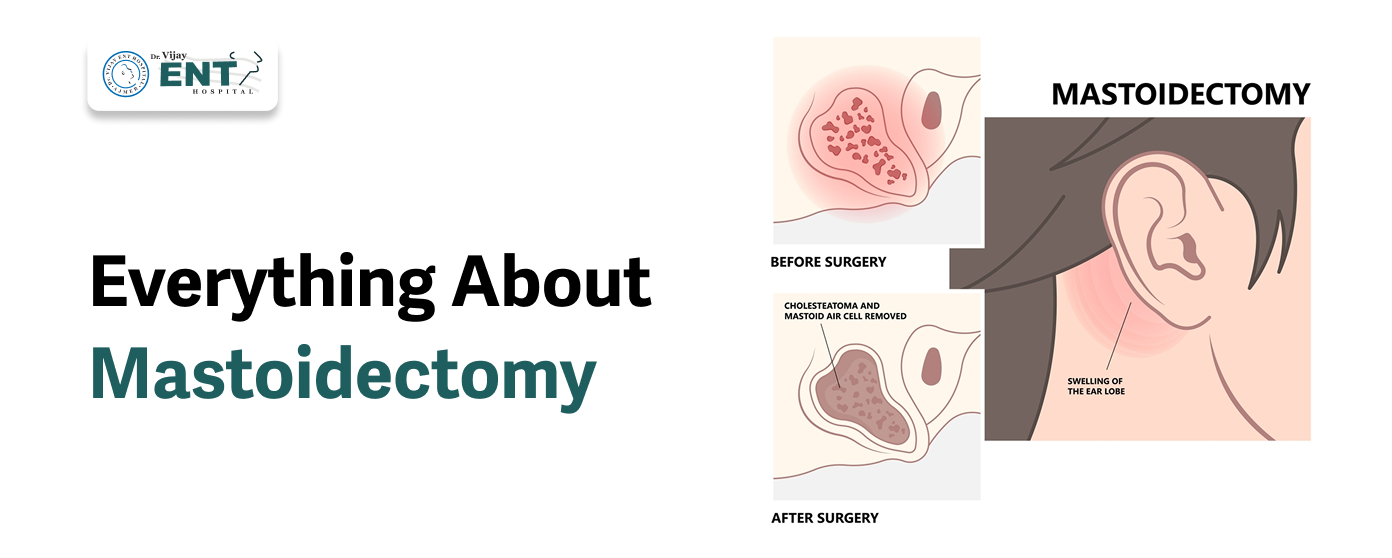
Mastoidectomy is a surgical procedure that eliminates diseased cells from the air-filled spaces in your mastoid bones. It is a part of the skull located behind the ears. Mastoidectomy is performed to treat cholesteatoma and ear infections that have infected the skull. Sometimes, just by listening to the disease or health-related issues, we get affected so much that, for a cure, we immediately rush to the doctor. However, for the best treatment and mastoidectomy recovery, you can always connect with the best ENT surgeon in India. For a deeper understanding, keep reading the full blog on mastoidectomy surgery, its procedure, and more.
Mastoidectomy surgery is performed to remove diseased mastoid air cells. These air cells form in the hollow spaces within your mastoid — a sponge-like, honeycomb-shaped bone that sits just behind your ear. Your body will give you several indications that you need a mastoidectomy surgery:
These are some common signs that point out the need for surgery.
Simple Mastoidectomy: This procedure is performed to remove infected air cells without affecting the middle ear or the ear canal.
Radical Mastoidectomy: In this procedure, the mastoid air cells, the posterior ear canal wall, the eardrum, and most middle ear structures (ossicles) are removed.
Modified Radical Mastoidectomy: For modified radical mastoidectomy, the surgeon attempts to preserve or reconstruct hearing by leaving some middle ear structures and the eardrum intact.
Bundy’s Procedure: A specific type of modified radical mastoidectomy used when disease (like a cholesteatoma) is limited to the attic area and hasn’t reached the middle ear.
A mastoidectomy surgery is performed when an ear infection spreads into the skull. This procedure is often performed to treat cholesteatoma. It refers to a noncancerous growth that occurs behind your eardrum, often termed as a complication of chronic ear infection. There will be cases where your ENT surgeon will recommend that you opt for the same during cochlear implant surgery. In case of a ruptured eardrum, you need to undergo mastoidectomy with tympanoplasty.
As a patient, we understand that your mind is flooded with questions like is mastoidectomy surgery painful, how serious is the surgery, and so on. We understand it, but before that, you need to know that the extent of surgery depends on your unique situation. A normal mastoidectomy will treat disease in your mastoid, keeping your ear canal and middle ear structures completely intact. A canal-wall-up mastoidectomy or tympan mastoidectomy detaches more bone than a simple mastoidectomy. This procedure helps your surgeon gain access to your middle ear: the space behind your eardrum, including your ossicles — the three tiny bones inside of your ear that transmit sound waves. This procedure leaves your ear canal completely intact.
Mastoidectomy surgery is generally considered safe. However, there are certain complications associated with this surgery that can be mitigated if proper care and attention are given to the patient. This surgery is particularly performed to clear infections present on the mastoid bones.
Before the mastoidectomy procedure, your healthcare provider will provide you with a set of instructions that need to be followed. You may be required to discontinue normal medications as a mastoidectomy is performed under general anesthesia. Additionally, you shall carry a family member or a trusted friend who can visit you at the ENT hospitals during your appointments.
You will be placed under general anesthesia, and your comfort levels will be monitored. After this, your surgeon will:
Mastoidectomy surgery usually takes about two to three hours to complete.
Well its believed that you shouldn’t feel any pain during your mastoidectomy. However, like any surgery, patients can observe some mild discomfort after the procedure. The incision behind your ear will likely be sore, and your ear may feel full or stuffy. You can manage these side effects with over-the-counter (OTC) pain relievers, such as acetaminophen or ibuprofen. Your ENT surgeon will also give you post-operative instructions that’ll speed up the healing phase.
After your mastoidectomy surgery, you’ll wake up in recovery. Your medical team will monitor your progress, and when you’re ready, you’ll be able to go home. Your surgeon will give you specific postoperative guidelines. It’s important to follow these closely. Moreover, you can get admitted into an ENT hospital where your recovery will be quick.
Mastoidectomy surgery is performed to treat chronic ear infections and minimize their occurrence. In addition, the procedure can prevent serious complications of cholesteatoma, such as:
No matter whether the surgery is minor or major, there are potential risks or complications attached to it. Mastoidectomy surgery complications may include:
Complete mastoidectomy surgery recovery takes about six to twelve weeks. After undertaking the surgical procedure, patients are always curious whether they will be able to hear or not. So don’t worry as hearing can return or improve after a mastoidectomy, though it depends on the extent of disease, damage, and the type of surgery performed. According to ENT specialists, most people can resume their work, school, and other routine activities in approximately one to two weeks.
Mastoidectomy is mostly successful, but the outlook varies based on the reason for the surgery and the type of mastoidectomy performed. The primary goal of this surgery isn’t to restore hearing, but to eliminate the infection that can lead to further problems. It’s important to note that some hearing loss is common with radical or canal-wall-down mastoidectomy.
The mastoidectomy surgery cost is dependent on several factors and the extent of the infected ear. However, to give you an estimated idea, mastoidectomy surgery costs in India generally range between ₹34,000 and ₹1,10,000. It also depends on the city, hospital, and type of procedure opted for.
When should I see my healthcare provider? This is one of the most asked questions. The simple answer to this is that if you’ve recently undergone a mastoidectomy procedure, you should call your healthcare expert in cases of:
Mastoidectomy surgery is performed on diseased, infected honeycomb-like bone (mastoid air cells) behind the ear, preventing severe complications like hearing loss, deafness, facial paralysis, and life-threatening infections spreading to the brain. For the best ear care, you can always connect with an ENT surgeon.

Dr. Vijay Gakhar is a renowned ENT specialist and expert Microtia surgeon in Rajasthan, India. Carrying the MBBS degree from the prestigious SMS Medical College, Jaipur, he holds specialisation with an MS in Otolaryngology ENT (Ear, Nose, and Throat) from Jawaharlal Nehru Medical College (JLN), Ajmer. Besides known for performing the best ear reconstruction surgeries, Dr. Gakhar grabs expertise in all other ENT services such as Septoplasty, Myringoplasty, Nasal Endoscopy, Commando Surgery, and FESS (Functional Endoscopic Sinus Surgery), for over 20 years.