58-59 Balaji Nagar, St Stephen Circle, Makarwali Road, Ajmer, Rajasthan 305004


If you’ve been diagnosed with otosclerosis, your ENT specialist may recommend surgery to improve hearing. Two common surgical options are stapedectomy and stapedotomy. Both procedures are designed to bypass a fixed stapes bone and restore sound transmission to the inner ear. However, they differ in surgical technique, recovery, risks, and hearing outcomes. In this guide, we’ll compare stapedectomy vs stapedotomy to help you understand which procedure may be recommended for your condition.
Otosclerosis is a condition in which abnormal bone growth develops around the stapes bone in the middle ear. Over time, the stapes becomes fixed and loses its ability to vibrate normally, preventing sound waves from reaching the inner ear effectively. This commonly results in progressive conductive hearing loss and may also cause tinnitus or balance-related symptoms in some individuals.
The symptoms of otosclerosis may develop gradually and can include:
If left untreated, otosclerosis can significantly affect communication and quality of life.
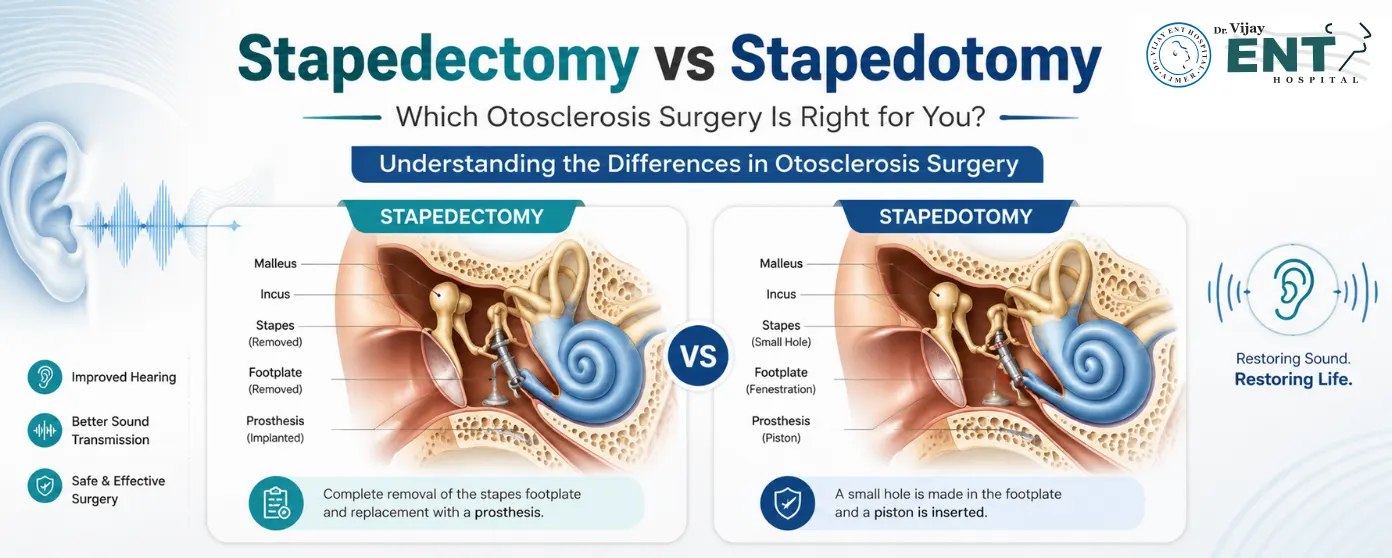
Stapedectomy is a surgical procedure to treat hearing loss caused by otosclerosis, a condition where the stapes bone gets fixed and cannot vibrate to transmit sound from the middle ear to the inner ear. Stapedectomy is one of several advanced ear surgery procedures used to restore hearing and improve sound transmission in patients with middle ear disorders.
In this procedure, the fixed stapes bone is replaced with an artificial prosthetic device to restore hearing and sound transmission.
Stapedotomy is a refined and less invasive procedure compared to stapedectomy. This is performed to treat conductive hearing loss from otosclerosis. In this surgery, a small, tiny hole is created in the stapes footplate to insert a prosthetic piston, helping to bypass the diseased bone to restore sound transmission.
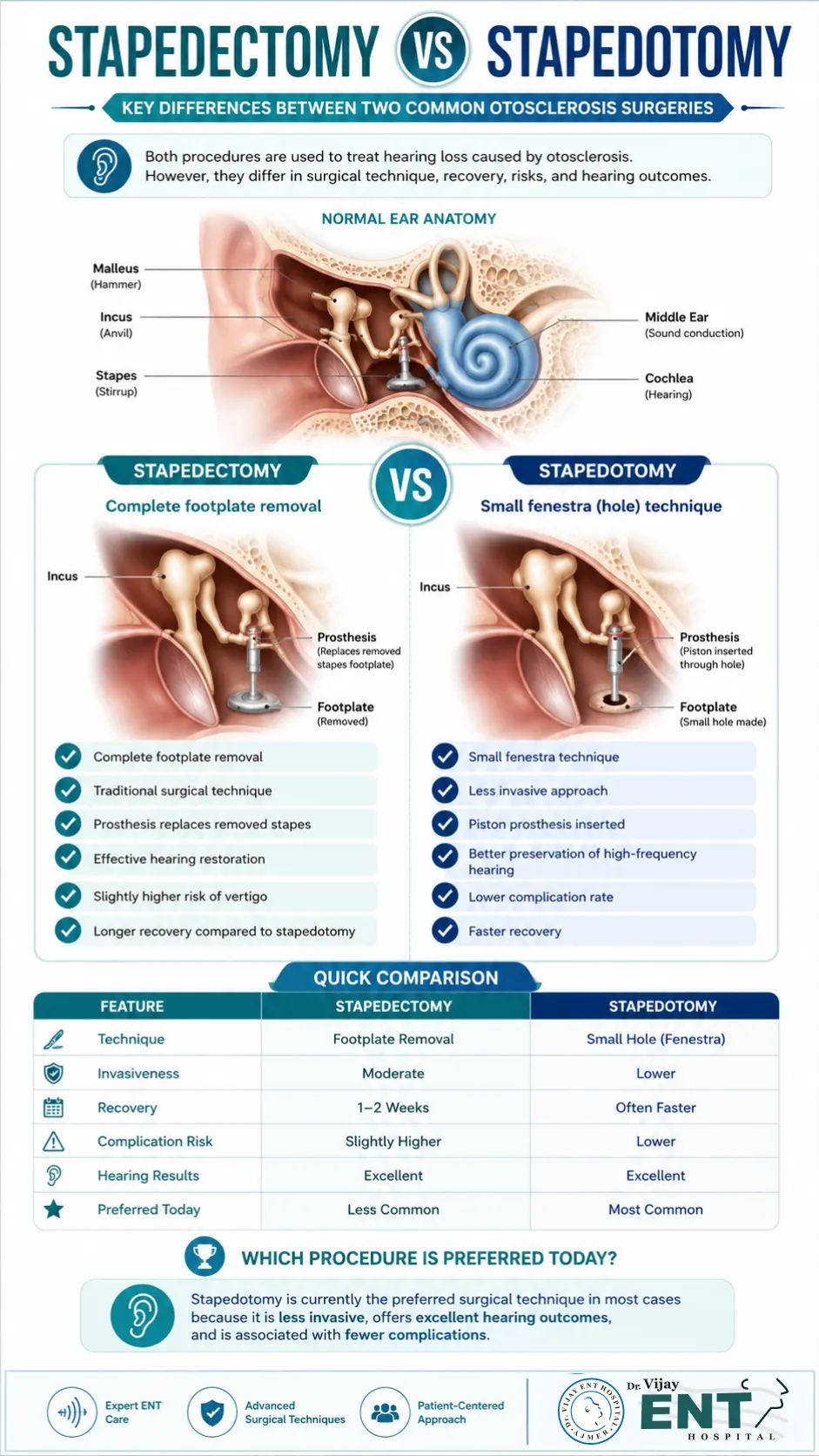
Both Stapedectomy and Stapedotomy are highly successful surgical procedures to treat hearing loss caused by otosclerosis. However, stapedotomy is preferred today, as it involves using a laser/drill to create a small hole in the stapes footplate for a prosthesis, resulting in better safety and high-frequency hearing.
On the other side, stapedectomy involves the removal of the entire footplate.
Stapedotomy is generally associated with a lower risk of inner ear trauma and postoperative complications compared to traditional stapedectomy, because it results in fewer intraoperative and postoperative complications, as the inner ear is less disturbed.
While stapedectomy is associated with higher incidences of postoperative vertigo.
Stapedotomy is currently the preferred surgical technique in most cases because it is less invasive and generally associated with comparable or slightly improved hearing outcomes, fewer complications, and better preservation of high-frequency hearing.
In stapedotomy, surgeons use lasers or specialised microdrills to create a tiny hole in the stapes footplate.
While in stapedectomy, surgeons use operating microscopes, laser systems (CO2, Argon, or KTP), and micro-instruments like picks, hooks, and scissors.
Both of these surgical procedures are highly effective and provide hearing improvement. In some cases, patients with hearing problems caused by a perforated eardrum may require myringoplasty instead of stapes surgery. However, to have a clear understanding of how these surgeries treat hearing loss, depending on the underlying cause of hearing loss, ENT specialists may recommend different surgical treatments. For example, tympanoplasty is commonly performed to repair a damaged eardrum or middle ear structures, while stapedectomy and stapedotomy are specifically used for otosclerosis-related hearing loss. Here is the explanation:
In this condition, the stapes bone becomes frozen or fixed, stopping the sound vibrations from reaching the inner ear. This causes hearing loss.
Stapedectomy is performed to remove the fixed or frozen stapes bone completely.
Stapedotomy is a less invasive and yet modern surgical procedure. Instead of removing the entire stapes bone, it creates a tiny hole.
Both surgical procedures involve prosthetic devices that allow sound vibrations to bypass the fixed stapes bone.
The result: The inner ear receives vibrations, converting them into nerve signals for the brain, which effectively results in better hearing.
| Feature | Stapedectomy (Total/Subtotal Removal) | Stapedotomy (Small Hole Method) |
| Technique | Removal of the entire top structure (superstructure) and the base (footplate) of the stapes bone. | Creating a small, precise hole (0.4–0.6 mm) in the footplate using a laser or micro-drill. |
| Prosthesis | Wire-tissue or small piston. | Typically, a piston prosthesis (Teflon or wire). |
| Risks (Low Overall) | Higher risk of vertigo, perilymph fistula (fluid leak), and sensorineural hearing loss. | Lower risk of complications; less trauma to the inner ear. |
| Common Complications | Vertigo, temporary taste disturbance, tinnitus, and persistent conductive loss. | Similar to stapedectomy, but at lower rates. Taste disturbance is common but usually temporary. |
| Recovery Time | Generally, 1–2 weeks for daily activities, 4-6 weeks for full recovery. | Often faster rehabilitation than stapedectomy, with similar restrictions. |
| Hearing Results | Excellent, but may have slightly lower high-frequency gain than stapedotomy. | Superior high-frequency hearing improvement; lower incidence of high-frequency hearing loss. |
| Long-term Success | High success rate, but slightly higher revision rate due to complications. | High success rate with better long-term stability in high frequencies. |
| When it’s used | Usually, if the footplate is severely affected or in revision surgery. | Preferred primary technique for most otosclerosis cases. |
Stapedectomy or stapedotomy may be recommended for patients who:
A detailed hearing assessment and ENT examination help determine whether stapes surgery is appropriate.
Recovery following stapes surgery is usually smooth. Most patients can return to routine daily activities within 1 to 2 weeks, although complete healing may take 4 to 6 weeks.
During recovery, patients are generally advised to:
Hearing improvement may be noticed gradually as the ear heals.
Although both procedures are considered safe and highly successful, potential risks may include:
Generally, it is considered that both stapedectomy and stapedotomy are successful procedures to treat conductive hearing loss, with an exceeding 90% – 95% success rate.
However, both are standard procedures; the stapedotomy is currently considered the safest, least invasive, modern, and most common technique used by surgeons. Stapedectomy is the traditional version of stapes bone surgery.
Ultimately, the choice between stapedectomy and stapedotomy depends on several factors, including the extent of otosclerosis, middle ear anatomy, hearing test results, and the surgeon’s clinical assessment. Your ENT specialist will recommend the most appropriate procedure based on your individual condition.
If you’re experiencing hearing loss due to otosclerosis, early diagnosis and consultation with an experienced ENT specialist can help restore hearing and improve the quality of life. Dr Vijay Gakhar provides comprehensive evaluation and advanced surgical treatment for otosclerosis, including stapedotomy and stapedectomy.
Schedule a consultation today to discuss the most suitable treatment option for your hearing condition.
Stapedotomy is generally preferred today because it is less invasive and may offer similar or better hearing outcomes with fewer complications.
Most studies report hearing improvement in more than 90% of properly selected patients.
Most patients resume normal activities within one to two weeks, while complete healing may take several weeks.
Although long-term results are excellent, hearing loss may gradually return in some patients, requiring further evaluation.
Most patients experience only mild discomfort after surgery, which is manageable with medication.
| Disclaimer: This article is intended for educational purposes only and should not be considered a substitute for professional medical advice, diagnosis, or treatment. Consult a qualified ENT specialist for personalised recommendations. |

Dr. Vijay Gakhar is a renowned ENT specialist and expert Microtia surgeon in Rajasthan, India. Carrying the MBBS degree from the prestigious SMS Medical College, Jaipur, he holds specialisation with an MS in Otolaryngology ENT (Ear, Nose, and Throat) from Jawaharlal Nehru Medical College (JLN), Ajmer. Besides known for performing the best ear reconstruction surgeries, Dr. Gakhar grabs expertise in all other ENT services such as Septoplasty, Myringoplasty, Nasal Endoscopy, Commando Surgery, and FESS (Functional Endoscopic Sinus Surgery), for over 20 years.