58-59 Balaji Nagar, St Stephen Circle, Makarwali Road, Ajmer, Rajasthan 305004



A nasal fracture is a break or crack in the small bones that form the bridge of the nose. Such fractures typically occur due to falls, sports-related injuries, road accidents, or direct trauma to the face. Because the nose is located in the center of the face, even a minor injury can lead to swelling, bleeding, and visible changes in its shape. If the bones or the nasal septum become displaced, it can also impair breathing.
This blog discusses the cause, symptoms, treatment options, and the recovery process from an ENT (Ear, Nose, and Throat) perspective, helping you understand when to seek medical attention. If the injury is recent, do not attempt to push the nose back into place yourself. An initial evaluation by an ENT specialist helps prevent overlooked complications and improves the likelihood of a smooth recovery.
Nasal fracture refers to a break in one or more of the bones within the nose. These injuries can range in severity from minor fractures with minimal symptoms to more severe breaks that can lead to significantly more pain and the possibility of deformity.
At Vijay ENT Hospital, patients typically present with visible nasal deformity or a crooked nose following an injury, accompanied by pain, swelling, bruising around the nose and eyes, and difficulty breathing through one or both nostrils. Our team assesses the cause of the injury— such as workplace accidents, sports-related incidents, or road traffic accidents— and explains the appropriate treatment options for various types of fractures, including simple, septal, open, displaced, or comminuted fractures. We provide transparent pricing and ongoing follow-up support.
The symptoms associated with nasal fractures vary in severity, and this depends on the type of fracture, its location, and the extent of injury to the surrounding tissues. The most prominent symptoms that indicate the presence of a nasal fracture include the following:
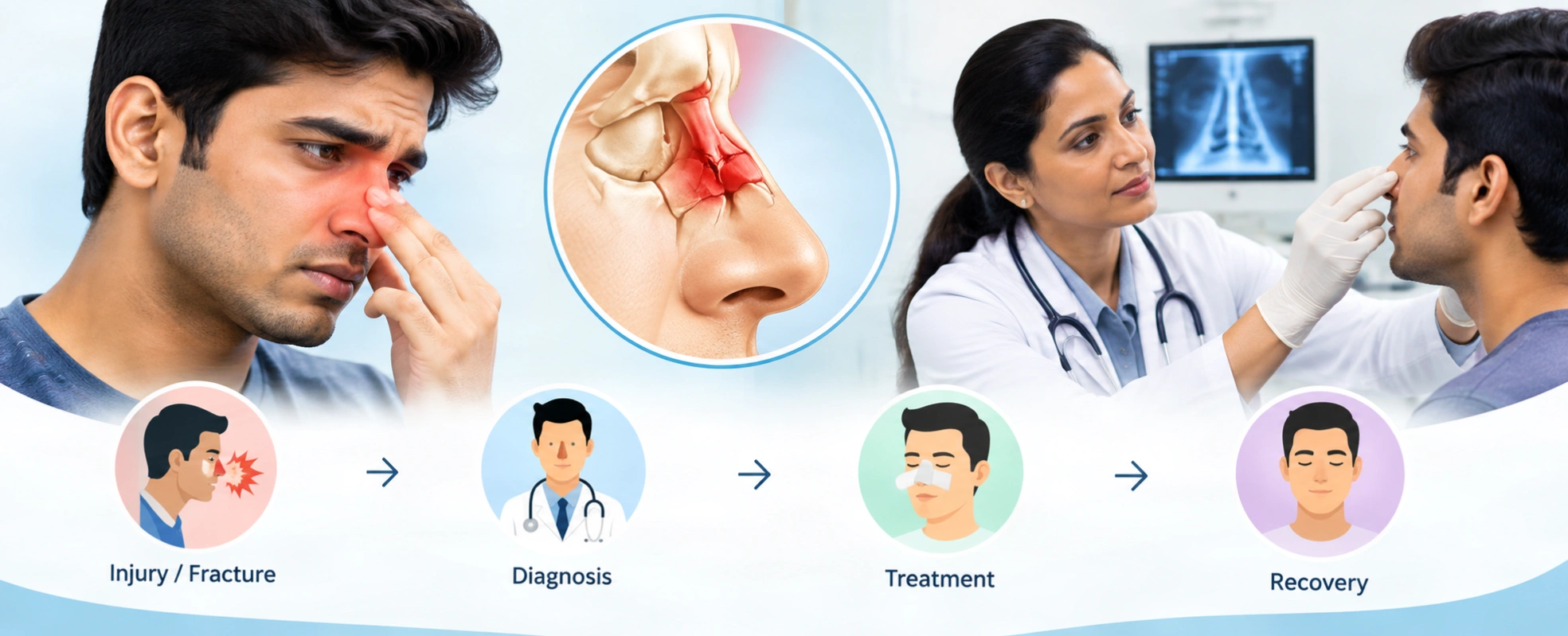
Diagnosis of a nasal bone fracture starts with a careful physical examination. The ENT specialist will ask you about the history of the injury, check the damaged area for tenderness and edema, detect any deformities. Assess the airflow from each nostril.
The X-ray isn’t constantly required for an ENT professional to observe the nasal injury. Instead, the health practitioner would possibly advocate a CT test if the affected person has a complex facial trauma, orbital fracture or different intense conditions.
At Dr. Vijay ENT Hospital, advanced diagnostic imaging supports ENT assessment when deeper facial injury is suspected. This helps doctors decide whether simple observation, closed realignment or surgery is the safest option.
For the first few hours after injury, basic care can reduce swelling and discomfort:
Treatment depends on the severity of injury, timing of consultation, breathing difficulty and change in nasal shape. The main goal is to restore function, reduce deformity and prevent complications.
For a simple nasal bone fracture with straight alignment, treatment may involve pain control, swelling management, and follow-up. If the nose is displaced, an ENT specialist may recommend closed reduction, a procedure that gently realigns the bones without external cuts.
Closed reduction is often considered after swelling subsides, usually within 7 to 14 days in adults. Children may need earlier assessment because their bones heal faster. Delayed treatment can make realignment more difficult.
Severe injuries, old deformities or associated septal damage may require septoplasty, rhinoplasty or reconstructive surgery. If trauma has affected the nasal passages or sinuses, specialized rhinology and sinus diseases treatment can help evaluate airway and sinus health. If long-standing sinus blockage is also present, an ENT doctor may separately assess whether sinusitis surgery is relevant after healing.
In the case of simple, non-displaced fractures or those that were treated early, treatment includes the following:
In the case of displaced and complex fractures, or those that were not treated early, treatment includes the following:
Recovery after a nasal bone fracture is usually gradual. Swelling often makes the injury look worse in the first few days, then slowly improves. Do not remove any packing or splints unless your doctor tells you to. Most people return to routine non-contact activities within a few days, depending on pain and swelling. Contact sports or any other activities should be avoided until an ENT specialist confirms that healing is adequate. Complete bone healing requires approx. 6-8 weeks, with full tissue remodeling continuing for several months.
For best care, avoid nose blowing for at least 7–10 days to prevent disruption of healing tissues. Protective equipment including face shields becomes essential when returning to high-risk activities. Sun protection prevents permanent pigmentation changes in bruised areas during the first few months of healing.
A few important suggestions include:
| Days (After Injury | What commonly happens | Recommendation (for care) |
| First 48 hours | Pain, swelling and possible bleeding | Ice packs, rest and urgent review if warning signs appear |
| Week 01 | Bruising may peak, pain often reduces | ENT assessment and monitoring of breathing |
| Week 02-03 | Swelling reduces enough to judge shape | Closed reduction may be considered if displaced |
| Week 02 – 06 | Bones continue healing | Avoid contact sports and protect the nose |
| After 6 weeks | Persistent blockage or deformity becomes clearer | Follow-up if breathing or appearance is affected |
Some minor injuries can heal without realignment if the nose remains straight and breathing is normal. However, an ENT check is important to rule out septal haematoma, displacement or hidden airway problems.
Ideally, see an ENT specialist within the first few days. Seek immediate care if bleeding is heavy, both nostrils are blocked, vision changes occur or there are signs of head injury.
Most nasal fractures are not dangerous and heal well, but some injuries carry complications. A septal hematoma (blood collecting inside the wall between the nostrils) can damage cartilage if not drained promptly. Heavy or persistent bleeding, clear fluid leaking from the nose, or associated injuries to the eyes, face, or head make the situation more serious and require urgent care.
Nasal bone fracture surgery risks include infection, bleeding, numbness, scarring, and incomplete correction requiring revision surgery. Closed reduction techniques have lower complication rates than open surgical approaches.
No. Many cases need only observation, pain relief and follow-up. Surgery or closed realignment is considered when the nose is displaced, breathing is affected or deformity is likely.
Swelling and bruising often improve in 1 to 2 weeks. Bone healing usually takes several weeks, so contact sports and facial impact should be avoided until medical clearance.
Yes. Untreated displacement or septal injury can lead to chronic nasal blockage, snoring, recurrent sinus symptoms or a visible bend in the nose.
While there is no absolute time limit, nose break treatment becomes more complex after six months. Old fractures may require osteotomy or complex reconstruction, with lower success rates and longer recovery times than acute treatment.

Dr. Vijay Gakhar is a renowned ENT specialist and expert Microtia surgeon in Rajasthan, India. Carrying the MBBS degree from the prestigious SMS Medical College, Jaipur, he holds specialisation with an MS in Otolaryngology ENT (Ear, Nose, and Throat) from Jawaharlal Nehru Medical College (JLN), Ajmer. Besides known for performing the best ear reconstruction surgeries, Dr. Gakhar grabs expertise in all other ENT services such as Septoplasty, Myringoplasty, Nasal Endoscopy, Commando Surgery, and FESS (Functional Endoscopic Sinus Surgery), for over 20 years.